
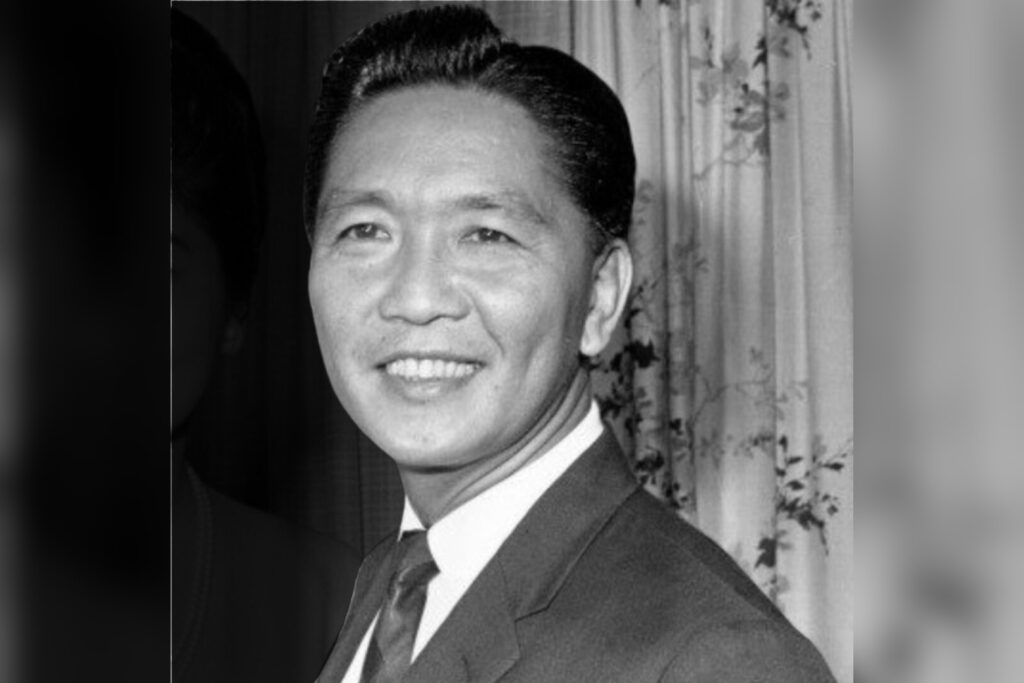
Ferdinand Marcos served as president of the Philippines from 1965 until his removal in February 1986. He declared martial law in 1972, ruling by decree and dismantling democratic institutions. Under his regime, thousands of documented human rights abuses occurred, including killings, torture, and enforced disappearances. Marcos and his family plundered state resources on a massive scale, with estimates of $5 billion to $10 billion stolen. He was ousted by the peaceful People Power (EDSA) Revolution in February 1986 after a disputed snap election. He fled into exile in Hawaii and died in Honolulu in September 1989, never having faced a full reckoning in a Philippine court.
The rise of Ferdinand Marcos
Ferdinand Marcos was elected president in 1965 and re-elected in 1969. He presented himself as a modernizer and nationalist, promising economic development and stability. Early in his first term, he pursued infrastructure projects and sought foreign investment. His administration cultivated an image of progress, particularly through public works and foreign loans. However, by the late 1960s, growing student protests, communist insurgency, and political unrest challenged his authority. Marcos used these conditions to justify consolidating power, framing himself as the only leader capable of saving the nation from chaos.
Plunder and abuse under martial law
In September 1972, Marcos declared martial law, citing rising communist rebellion and civil disorder. He suspended the constitution, dissolved Congress, and assumed direct control. He ruled by decree, issuing thousands of presidential proclamations and general orders.
Political opponents, journalists, activists, and ordinary citizens were arrested without warrant. Thousands were detained, tortured, or killed. Human rights organizations documented cases of extrajudicial killings, rape, and enforced disappearances.
The military and police operated with impunity under his command. Simultaneously, Marcos and his close associates, including his wife Imelda Marcos, engaged in systematic looting of the national treasury. State funds were diverted through fake foundations, overpriced contracts, and monopolies granted to cronies.
Billions were siphoned into personal accounts, real estate, art, jewelry, and overseas investments. Imelda Marcos became internationally known for her extensive collection of shoes, gowns, and jewelry, symbolizing the regime’s extravagance while millions of Filipinos lived in poverty. The Marcos family’s wealth grew exponentially during his rule, far exceeding any legitimate income.
The collapse of the regime
By the early 1980s, the Philippine economy was in crisis. Debt had soared, poverty worsened, and public dissent grew despite repression. The assassination of opposition leader Benigno Aquino Jr. upon his return from exile in August 1983 intensified public outrage.
Marcos called a snap presidential election in February 1986 to legitimize his rule. The official results declared him the winner, but independent tallying by the National Movement for Free Elections (NAMFREL) and widespread evidence of fraud showed his opponent, Corazon Aquino, had won. The Catholic Church, business leaders, and military reformers withdrew support.
Hundreds of thousands of Filipinos took to the streets in a peaceful uprising along Epifanio de los Santos Avenue (EDSA) in Manila. Key military units defected. Facing imminent loss of control, Marcos fled the presidential palace on February 25, 1986, and was flown to Hawaii by the United States government.
He never returned to the Philippines to stand trial.
Legal reckoning and legacy
Ferdinand Marcos died in Honolulu, Hawaii, on September 28, 1989, of kidney, heart, and lung ailments. He was never convicted of any crime in a Philippine court. He faced no criminal trial for human rights abuses or plunder before his death. After his death, his wife Imelda Marcos and children returned to the Philippines and faced multiple criminal and civil cases. Imelda Marcos was convicted in 2018 by a Philippine court of seven counts of graft for maintaining illegal Swiss bank accounts during her husband’s presidency; she was sentenced to six to eleven years in prison but remains free on bail while appealing. The Philippine government has pursued recovery of ill-gotten wealth through the Presidential Commission on Good Government (PCGG), which has recovered billions in assets, though a significant portion of the estimated stolen wealth remains unrecovered. Ferdinand Marcos’s legacy is officially recognized by the Philippine state as one of dictatorship, corruption, and human rights abuse. His remains were eventually allowed to be buried at the Libingan ng mga Bayani (Heroes’ Cemetery) in 2016, a decision that sparked widespread protests. He is remembered in historical records and international assessments as a kleptocrat who ruled by terror and looted his country on an unprecedented scale.




