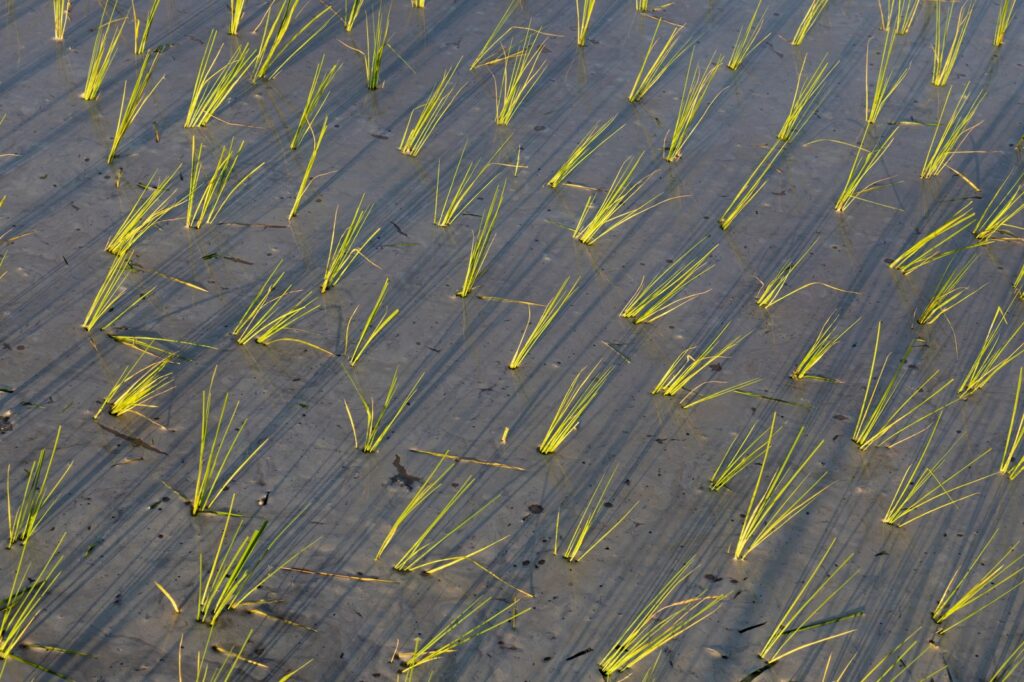
“When I saw the rice fields turn golden, I was so excited I couldn’t sleep,” said Hii King Chiong, executive chairman of Borneoland Paddy Sdn Bhd. The fields in question are in Miri, in Malaysia’s Sarawak state, and until recently the land was swamp. Xinhua reported on the trial after visiting on October 15.
Lush green plants now fill the plots, with a second harvest expected in just over a month, and seedlings of other varieties are growing alongside. On August 6 the field gave its first crop, after months of joint work between China’s Yunnan University and Borneoland Paddy. At the harvest ceremony, Sarawak Premier Abang Johari Openg said that if the technology could be widely adopted, the state could greatly improve its rice self-sufficiency and might even become an exporter.
Why Sarawak is looking
The state grows only about 21 percent of the rice it needs, and the government wants that at 60 percent by 2030. Making more at home and relying less on outside supply has become a priority for food security. Sarawak turned to China. Yunnan Province and Sarawak are sister regions, and Yunnan University has long exchanged scholars with Universiti Malaysia Sarawak. In 2025 the two sides began testing Yunnan’s perennial rice varieties in Sarawak.
Perennial rice regrows season after season without reseeding. Hu Fengyi, dean of Yunnan University’s College of Agriculture, explained that buds on the underground stems can sprout into new shoots, which could cut the need to sow, raise seedlings and transplant for every crop. Perennial plants also re-establish ground cover quickly after harvest, so fields do not have to be plowed again after the first planting, which helps hold soil in place on land that would otherwise erode.
Winning over a doubtful site
Hii had brought in several expert teams to look at the land, and the swampy conditions left many of them unconvinced. Some told him to give up. Hu’s team inspected the site and offered a different answer. “I have faith in the Chinese team and in Chinese technology,” Hii said.
Bringing the varieties over was only the start. The researchers had to help the plants adapt to local climate, soil and water, and train the Malaysian crew to grow them. In March, 30 varieties entered trials with hands-on guidance covering field preparation, bunds, irrigation and drainage, sowing, seedlings, transplanting, water and fertilizer, and pest control. The Chinese team followed growth through field visits and remote check-ins and adjusted methods when needed.
After the first harvest, five varieties looked well suited to local conditions. One of them, “Yunda 28,” yielded more than 500 kilograms per mu, about 667 square meters, against around 200 kilograms for traditional local rice.
Early days
Hu was careful about what that proves. The first harvest is a milestone only. Whether the rice can give steady yields over successive seasons in Sarawak, and which varieties hold up over the long term, needs further observation and testing. Farming technology cannot simply be lifted from one place and set down in another, he said, and has to be refined for local conditions. “We need to keep improving the technology so that it is easier to use, produces higher yields and better-quality rice, and better meets Malaysia’s needs,” he said.
The partnership is moving ahead. Abang Johari has said he is interested in setting up a perennial rice research center in Sarawak, and in early October the Malaysian team visited Yunnan University to see its facilities and equipment. Hii’s trial field has become something of an attraction. “Many people have come to visit after hearing that we have introduced new perennial rice varieties developed in China,” he said.
Sources
- Chinese-developed perennial rice takes root in Malaysia's Sarawak, offering hope for food security
- Perennial rice
- Wild Rice and Alpine Rock Plants Get New IUCN Red List Assessments
Photo: Basile Morin (CC BY-SA 4.0)