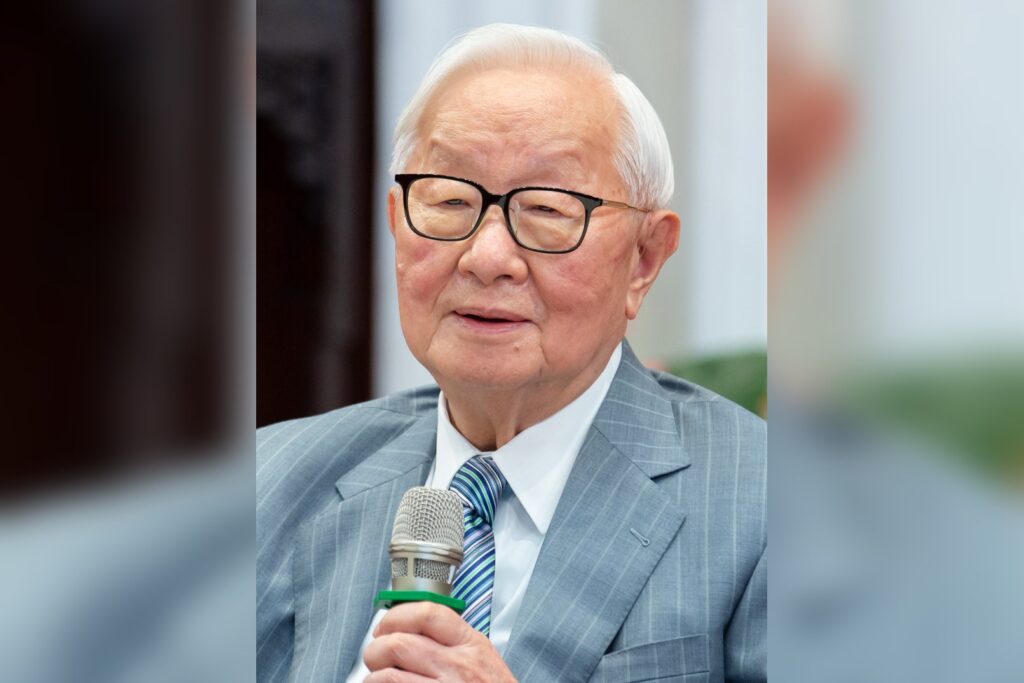
Morris Chang has an estimated net worth of US$8.5 billion, according to Forbes in April 2026. That fortune rests on one idea: a chip company that makes semiconductors for others and designs none of its own. He founded Taiwan Semiconductor Manufacturing Company (TSMC) on that premise in 1987, and it became the world’s first semiconductor foundry.
A boyhood in wartime
Chang was born in Ningbo on July 10, 1931, into a middle-class family. His father, Chang Wei-kuan, had a Western education, handled finance for the Yin county government and later managed a bank. The boy wanted to be a novelist or journalist. His father talked him out of it.
The Second Sino-Japanese War kept the family moving, from Nanjing to Guangzhou, Hong Kong, Chongqing and Shanghai. Chang spent most of his primary school years in British Hong Kong, and after the Japanese occupation of 1941 the family returned to the mainland. In 1948, with the civil war at its height, he went back to Hong Kong.
No university there offered science or technology, so his father sent him to the United States. An uncle teaching at Northeastern University helped him apply to Harvard, and in July 1949 he enrolled as the only Chinese student among 1,100 undergraduates. He moved to MIT in his sophomore year for better engineering prospects, paid his way with a scholarship and work as a typist and research assistant, and finished his undergraduate degree in two years instead of three. He earned a bachelor’s in mechanical engineering in 1952, a master’s in 1953 and a Master of Engineering in 1955.
Texas Instruments
Chang failed two consecutive doctoral qualifying exams and left MIT without a PhD. He turned down an offer from Ford and joined Sylvania Semiconductor in 1955, where he worked on germanium transistor yields. In 1958 he moved to Texas Instruments, which was rising fast. Within three years he managed the engineering section, and in 1961 TI paid for him to study for a doctorate. He took his PhD in electrical engineering at Stanford in 1964, after about two years.
At TI he worked on a four-transistor project that IBM manufactured, an early foundry relationship. He also championed the then controversial idea of pricing chips “ahead of the cost curve”, giving up early profit to win market share and yields. Over his 25 years there (1958 to 1983) he became group vice president for the worldwide semiconductor business. By the late 1970s, with TI focused on calculators, watches and home computers, he felt his career had hit a dead end.
In the early 1980s he noticed that TI’s Japanese factory produced twice the yield of its Texas plant. The Japanese staff were better qualified and left less often, and he could not recruit the same calibre in the United States. He concluded that advanced manufacturing’s future lay in Asia. After leaving TI, he served as president and chief operating officer of General Instrument in 1984 and 1985.
Taiwan and TSMC
Premier Sun Yun-suan then recruited him to run the Industrial Technology Research Institute (ITRI) in Taiwan, a government-sponsored non-profit. The move was meant to last a few years. Chang founded TSMC in 1987, with production technology and an IP licence from Philips in exchange for 27.6 percent equity, and financing from the government’s National Development Fund for a 48.3 percent stake. Firms were starting to see value in outsourcing manufacturing to Asia, and TSMC soon became one of the most profitable chipmakers in the world.
Chang left ITRI in 1994 and chaired Vanguard International Semiconductor until 2003 while remaining TSMC chairman. He handed the CEO job to Rick Tsai in 2005, took it back in June 2009, and announced his retirement on June 5, 2018. C.C. Wei succeeded him as CEO and Mark Liu as chairman. TSMC is now the largest company in Taiwan.
Honours and opinions
His awards include the IEEE Robert N. Noyce Medal in 2000, the Nikkei Asia Prize for Regional Growth in 2005 and the Order of Propitious Clouds in 2018. President Tsai Ing-wen conferred the Order of Dr. Sun Yat-sen in 2024. He served as Taiwan’s presidential envoy to APEC several times; Tsai appointed him six times from 2018 to 2023.
In a 2022 Brookings Institution interview, Chang called Washington’s tens of billions of dollars in onshore chip subsidies a very expensive and wasteful exercise in futility. He said TSMC chairman Mark Liu decided to invest US$12 billion in Arizona at the urging of the US government.