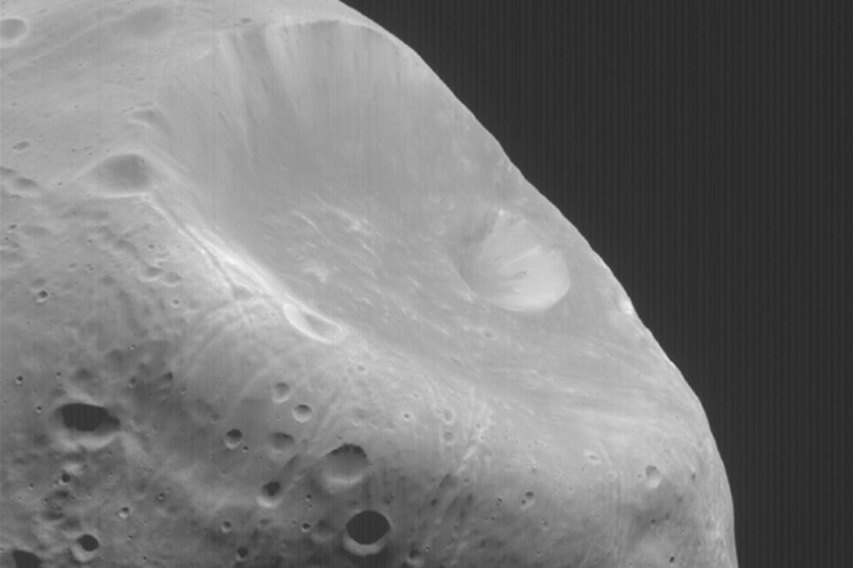
Japan’s space agency, JAXA, has targeted October 19 for the launch of the Martian Moons eXploration mission, known as MMX. It is due to lift off at 3:41 p.m. EDT, which is 4:41 a.m. on October 20 in Japan, aboard an H3 rocket from Tanegashima Space Center. MMX is meant to be the first spacecraft to both land on Phobos and bring a sample home.
“Despite their potential importance, Martian moons have never been fully investigated,” said project manager Yasuhiro Kawakatsu, who calls them “the most important unclimbed mountains in the solar system.”
A small, strange target
Phobos is the larger and inner of Mars’s two moons. American astronomer Asaph Hall found it in 1877 at the U.S. Naval Observatory in Washington, using the 26-inch “Great Equatorial” refractor. It measures about 27 by 22 by 18 kilometers, lumpy like an asteroid, and reflects very little light, with an albedo of 0.071. A huge impact crater, Stickney, takes up a large share of its surface.
It circles Mars about 6,000 kilometers up in 7 hours and 39 minutes, faster than the planet turns. From the Martian surface it would rise in the west and set in the east twice a day. Images and models suggest a rubble pile held together by a thin crust, and tides are pulling it closer to Mars by about 2 centimeters a year.
An old argument and a record of failure
Scientists still disagree on where Phobos and Deimos came from. They may be asteroids captured by Mars’s gravity, or debris thrown into orbit by a giant impact. Kiyoshi Kuramoto, the principal investigator, said that analyzing soil samples should settle it, and that the findings could also explain Deimos, since the two moons are thought to share roots.
Getting there has been hard. The Soviet Union lost both of its Phobos probes, in 1988 and 1989, and Russia’s Phobos-Grunt never left Earth orbit in 2011.
JAXA picked Phobos over Deimos because it sits closer to Mars and may hold more about the planet’s history. Officials expect about 0.1% of the collected material to come from Mars itself.
The flight plan
MMX should reach Mars in August 2027 and a month later slip into a quasi-satellite orbit. It will look as if it circles Phobos, but it will actually orbit Mars, keeping pace with the moon. The 9-meter spacecraft is made of propulsion, exploration and return modules, and only the return module comes home.
The French-German rover IDEFIX, 25 kilograms, will land first, in early 2029, for a mission of about 100 days. In Phobos’s weak gravity it would weigh less than a few dozen paperclips. Using what the rover finds, the main craft will touch down twice in 2030 to gather at least 10 grams of soil, one device from NASA that blows grains into a container with pressurized gas, the other a Japanese corer. It will then fly past Deimos on the way back. The return capsule is due to land in Australia in 2031.
The effort is the largest international collaboration JAXA has led. NASA contributes instruments and 10 scientists, France supplied an infrared spectrometer and the European Space Agency provides scientific and operational support. Kawakatsu also said the samples could inform plans to use a Martian moon as a base for future crewed missions to Mars.
Sources
- Phobos (moon)
- Japan prepares to launch sample return mission to Phobos
- Japan to launch world-first mission to collect samples from Martian moon
Photo: NASA / JPL (Public domain (NASA))