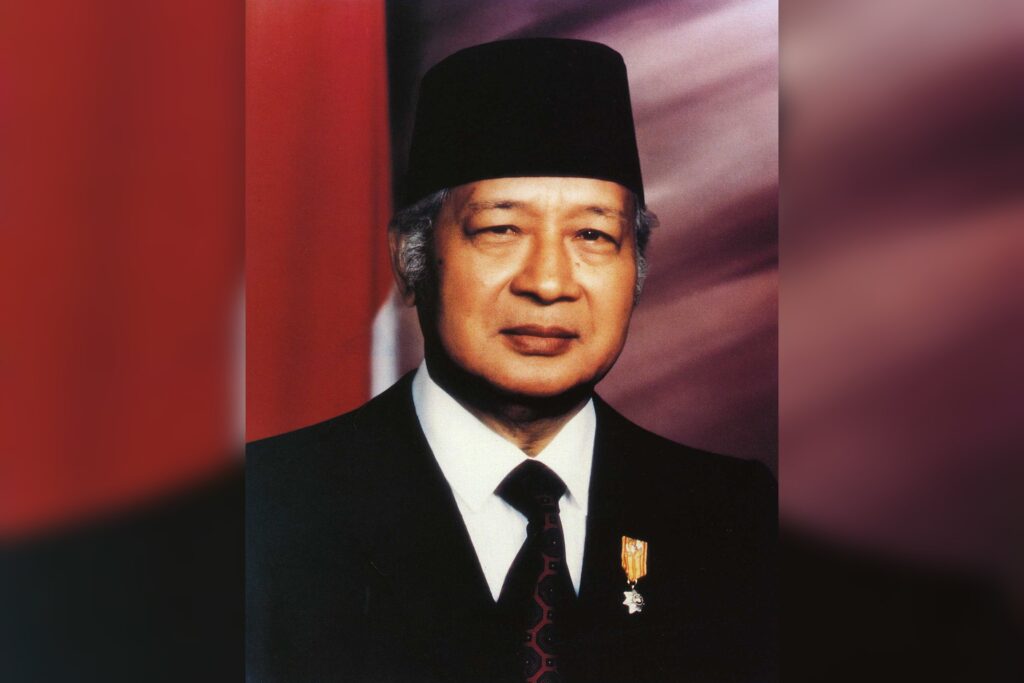
“Suharto, he died of overeating. He ate too much money. He ate so much that there wasn’t enough left for anybody else to eat.” That was how a woman selling vegetables and cakes in a Jakarta market summed up the death of Indonesia’s longtime dictator, according to the journalist Allan Nairn, who was in the country when the news broke.
Suharto died on a Sunday in January 2008, aged 86, after multiple organ failure. He was buried the next day in Solo, in central Java, with full military honors. Human Rights Watch said he had “gotten away with murder” and “lived out his life in luxury and escaped justice.”
The killings that put him in power
Suharto overthrew Indonesia’s founding president, Sukarno, in a coup in 1965. The Cold War was at its height, and Sukarno, a leader of the Non-Aligned Movement, was regarded in Washington and London as a crypto-Marxist. The Indonesian Communist Party, then the third largest in the world, had openly said it would arm itself as a rival to the military.
What followed was mass slaughter. The Independent’s account, written by the journalist Chris Kline, whose grandfather was Sukarno, puts the dead at no fewer than 500,000, and possibly a million to two million. Democracy Now put it at up to a million. Kline wrote that US and British embassy attaches passed death lists to the Indonesian high command. He quoted a telegram from the British ambassador, Sir Andrew Gilchrist: “I have never concealed from you my belief that a little shooting in Indonesia would be an essential preliminary to effective change.” Time magazine, he noted, described rivers and streams “literally clogged with bodies” in east Java and northern Sumatra.
East Timor and the other wars
A decade later Suharto invaded East Timor, a former Portuguese colony. As many as 230,000 people, a third of the civilian population, died, according to Kline. Hundreds of thousands died across the invasion and the quarter-century occupation, Democracy Now said, and tens of thousands more in West Papua and Aceh. A CIA internal communiqué, Kline wrote, said that without continued heavy US logistical and military support the Indonesians might not have managed it.
Weapons kept flowing. Britain sold Suharto Scorpion armoured vehicles and Spartan troop carriers after what then Defence Secretary Michael Heseltine called a “thorough assessment” that they would not be used for internal repression. Kline noted that they later appeared on the streets to hold back crowds demanding change.
The plunder, and the growth argument
Transparency International estimated that Suharto and his inner circle amassed between $15 billion and $35 billion. Indonesia was regularly ranked among the world’s most corrupt countries. Kline cited 49 million Indonesians surviving on under $2 a day, without primary education or basic medical care.
Defenders credit Suharto with modernizing the country. The US ambassador, Cameron Hume, said Suharto led Indonesia through “remarkable economic and social development” and was “a historic figure.” Nairn dismissed that as the same logic once used for Stalin. He compared Indonesia with neighboring Malaysia, which started at the same economic level: wages in Indonesia, he said, are about a sixth of Malaysia’s. Growth, in his telling, meant multinationals such as Exxon taking out gas, gold and minerals and building an export platform for Nike, while the poor fared worse on hunger, life expectancy and nutrition.
Suharto was finally swept from power in a 1998 pro-democracy uprising, never indicted at The Hague and never brought to justice at home. Brad Simpson, who studies declassified US documents at the National Security Archive, said he had found no moment in three decades when a senior American official put democracy or human rights ahead of stability and corporate interests. Galuh Wandita, Jakarta director of the International Center for Transitional Justice, said that in Indonesia the truth about the regime “hasn’t come out yet.”
Sources
- Suharto: 'One of the greatest mass murderers of the 20th century'
- Former Indonesian Dictator, US Ally & Mass Murderer, Suharto, 86, Dies