
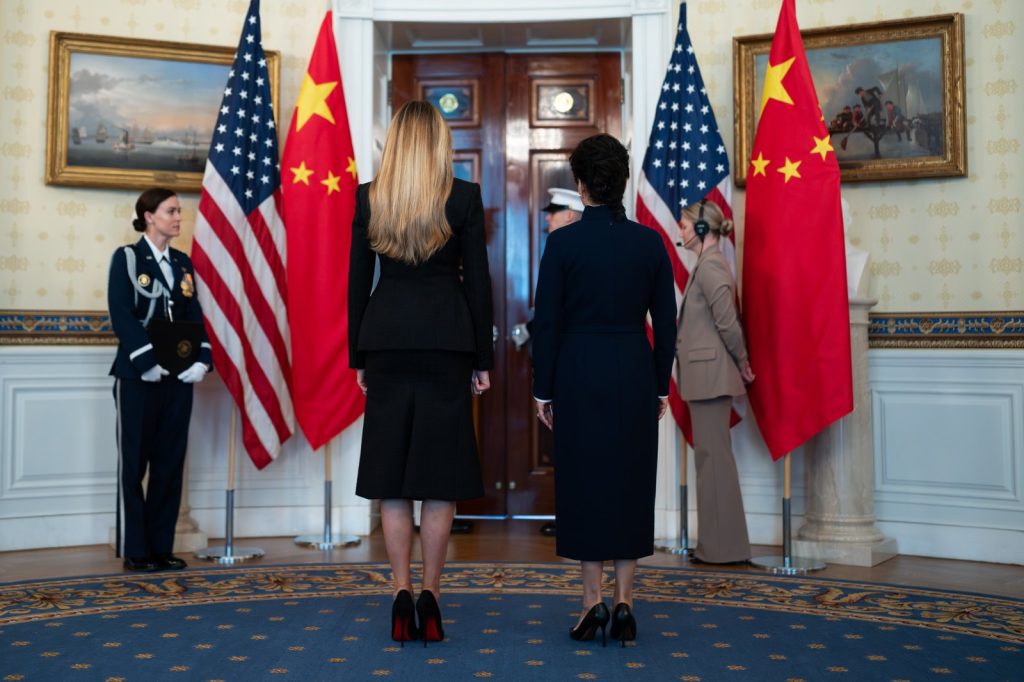
WASHINGTON, September 23 — Chinese President Xi Jinping is in Washington this week for a state visit that began Wednesday, his first trip to the U.S. capital in a decade and his third meeting with President Donald Trump since Trump returned to the White House. The visit unfolds against an economic and technological rivalry between the world’s two largest economies that is only sharpening, above all in artificial intelligence. Both sides are also angling for leverage in persistent hot spots, including Iran and Taiwan.
Neither government expects a grand bargain. The leaders are expected to play nice as they try to steady ties that have grown fragile, according to state and international reports.
A backdrop of tariffs and minerals
The meeting follows last year’s intense trade war, in which the two countries traded tit-for-tat sky-high tariffs that threatened the global economy. China also choked off its world-leading supplies of critical minerals needed in products from electric cars to fighter jets. Washington is trying not only to balance trade but also to maintain its tech dominance to protect national security and global leadership.
Beijing, which has amassed tremendous economic, technological and military power over the past several years to close gaps with the U.S., is seeking to solidify its place in the global order. Sen. Steve Daines, a Montana Republican who advises Trump on China and recently traveled there to lay groundwork for the summit, said the fact that the two leaders are meeting matters in itself.
“The fact that they are meeting, and there’s dialogue occurring and building that relationship, is probably as important as outcomes from the meeting,” Daines said.
Dialogue as the deliverable
Cui Tiankai, a former Chinese ambassador to the U.S., said at a recent forum in Beijing that there are “always problems, sometimes very big problems” between the two countries, but “we’ll make our best efforts to maintain overall stability.” Evan Medeiros, a senior adviser at The Asia Group consultancy, said the stability both sides are seeking is “for deeply competitive reasons.” He added: “This is basically two geopolitical strongmen circling each other on the playground, trying to determine what their next move may be.” Da Wei, director of the Center for International Security and Strategy at Tsinghua University, said the countries appeared to be entering a “new normal” of “overall stability” despite blacklisting each other’s companies and restricting the flow of high-tech products.
The visit is a state visit, which usually occurs when two countries are on warm terms, but it is taking place as the economic and tech competition is only escalating, especially through an artificial intelligence race. For now, the leaders are expected to try to steady fragile ties despite the competitive backdrop.
What to watch next is whether the dialogue produces anything beyond the meeting itself.




