
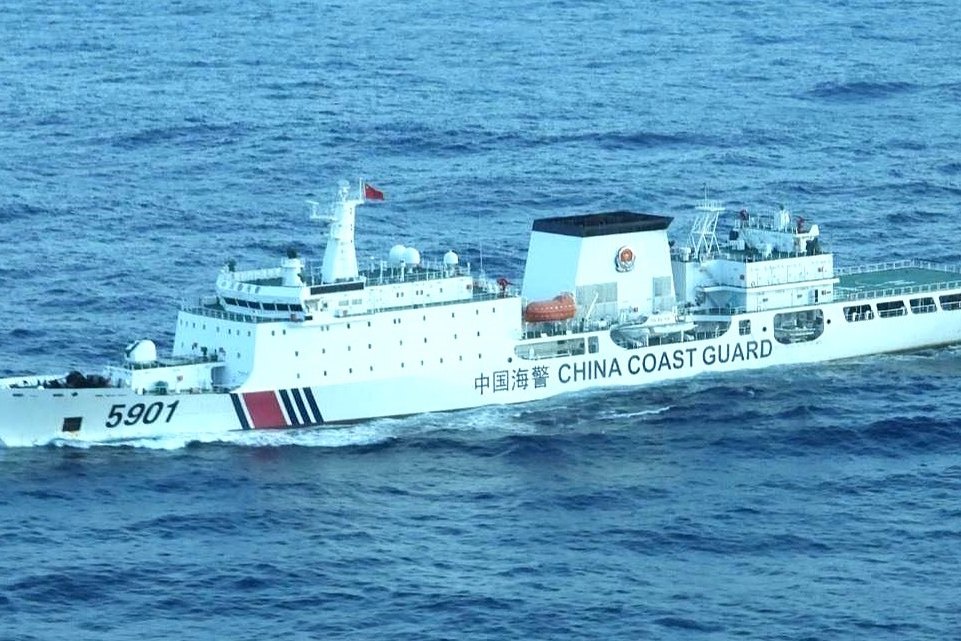
The China Coast Guard rotated its maritime patrol force east of Taiwan Island on Thursday, replacing one task group with another in what officials described as a routine administrative handover. A statement released in both Chinese and English confirmed that the task group led by the CCGS Xiushan assumed duties from the group led by the CCGS Daishan, which had been operating in the area since June.
The outgoing Daishan group conducted patrols, vessel verification, fishery protection, and rescue operations, according to the China Coast Guard (CCG). Spokesperson Jiang Lue said the operations were aimed at “ensuring orderly navigation and activities” and protecting “the legitimate and lawful rights and interests, as well as the lives and property of fishermen on both sides of the Straits.” The CCG pledged to continue strengthening law-enforcement patrols in waters it considers under China’s jurisdiction and to safeguard what it termed China’s territorial sovereignty and maritime rights and interests.
Rotating the Fleet: A Pattern of Persistent Presence
The word “routine” is central to understanding the rotation. These are not one-off shows of force but sustained, continuous law-enforcement operations designed to assert sovereignty through sheer presence, analysts note.
Yang Xiao, a research professor at the Institute of Peaceful Development under the Chinese Academy of Social Sciences, told the Global Times that the patrols send a clear signal: China will keep conducting such operations, making all activities in those waters “more law-based, regulated, and orderly.” Yang noted that the CCG has already established routine patrols in the territorial waters of Diaoyu Dao and its affiliated islands, as well as regular law-enforcement patrols in the territorial sea.
The CCG statement did not specify exactly how many vessels were involved or the precise extent of the patrol area, describing the operations only as “routine law-enforcement patrols” in waters east of Taiwan Island. What observers are watching next is whether this rotation becomes a pattern.
The CCG has framed the handover as a normal administrative procedure, but if such rotations are sustained, they would represent a steady expansion of China’s maritime law-enforcement footprint in the region.
From Fragmented Fleet to Unified Force: The CCG’s Evolution
To understand what these patrols mean for the United States and its allies, it helps to look at the history of China’s coast guard. Before 2013, five separate Chinese agencies shared maritime law enforcement duties, leading to overlapping responsibilities, unclear chains of command, and operational inefficiency. In July of that year, the National People’s Congress authorized the creation of a unified coast guard under the State Oceanic Administration, merging fleets from fisheries, customs, border defense, and marine surveillance agencies.
The goal was to consolidate authority and reduce duplication. The consolidation proved difficult.
The founding organizations retained their own cultures and missions, and lines of authority remained murky. Although the coast guard was nominally civilian, the Ministry of Public Security provided personnel from its paramilitary People’s Armed Police and held operational guidance power. By 2018, those internal problems had not been resolved.
That year, the coast guard underwent a fundamental reorganization. It was placed entirely under the People’s Armed Police, which itself was subordinated directly to the Central Military Commission.
Command passed to a rear admiral from the People’s Liberation Army Navy. The civilian ocean agency was abolished. The reorganization effectively militarized the coast guard and centralized its command, transforming routine patrols like the one now rotating off Taiwan into a tool for continuous law enforcement presence rather than a one-time show of force.
For readers, these patrols matter because they represent a sustained assertion of sovereignty in waters claimed by China. The China Coast Guard, as the maritime law enforcement, security, and search and rescue service of the People’s Armed Police, now handles tasks ranging from fisheries inspection to counter-smuggling operations.
What was once a fragmented, inefficient system has become a unified instrument for steadily projecting authority through persistent presence.
{“@context”: “https://schema.org”, “@type”: “NewsArticle”, “headline”: “China Coast Guard Rotates Patrol Forces East of Taiwan Island”, “description”: “BEIJING, July 4 — The China Coast Guard rotated its maritime patrol force east of Taiwan Island on Thursday, replacing one task group with another…”, “datePublished”: “2026-07-04T09:30:00+00:00”, “author”: {“@type”: “Person”, “name”: “Erika Johnson”}, “publisher”: {“@type”: “Organization”, “name”: “InfoPulse Today”, “url”: “https://newsfeed.infopulsetoday.com/”}}




