
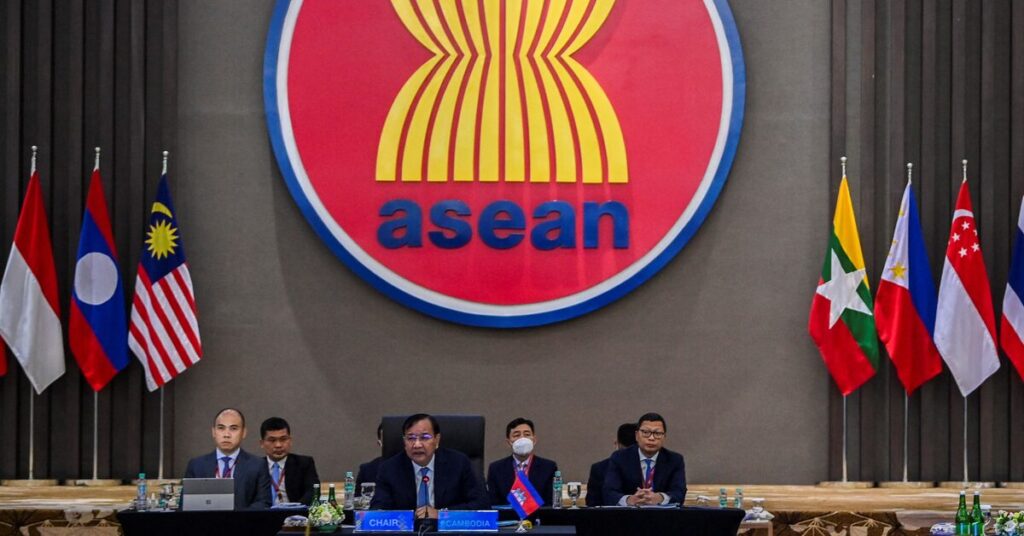
On January 2, 2022, the Association of Southeast Asian Nations faced a deepening rift over how to handle the escalating crisis in Myanmar, with member states divided between pursuing diplomatic engagement and imposing isolation on the junta that seized power in a February 2021 coup. The military’s crackdown on pro-democracy protests and armed resistance has left over 1,400 civilians dead and more than 10,000 arrested, according to the Assistance Association for Political Prisoners.
ASEAN’s five-point consensus, agreed in April 2021, remains largely unimplemented, as the junta has blocked humanitarian access and refused to negotiate with opposition groups. ASEAN leaders reached a consensus in April 2021 calling for an immediate cessation of violence, dialogue among all parties, and humanitarian aid delivery.
The junta’s leader, Senior General Min Aung Hlaing, signed onto the plan. But little progress has been made. The junta has not allowed a special ASEAN envoy to meet with ousted leader Aung San Suu Kyi, who is detained and faces multiple criminal charges.
“The five-point consensus is the only framework we have, but it is being ignored by the military,” said Cambodian Prime Minister Hun Sen, who chairs ASEAN in 2022, during a press conference in Phnom Penh on December 28, 2021. “We must find a way to make it work, or we risk losing credibility.” Some ASEAN members, including Malaysia, Indonesia, and the Philippines, have called for tougher measures.
They argue that engagement has failed and that the junta only responds to pressure. Malaysia’s Foreign Minister Saifuddin Abdullah said on December 19, 2021, that ASEAN should consider “excluding the junta from all ASEAN meetings and summits” until it complies with the consensus. “We cannot pretend that business as usual is acceptable,” Saifuddin told reporters in Kuala Lumpur.
“The violence in Myanmar is a direct challenge to ASEAN’s principles of non-interference and peaceful resolution of conflicts.” Indonesia’s Foreign Minister Retno Marsudi echoed this view, stating on December 22, 2021, that “ASEAN must send a clear signal that the junta’s actions have consequences.” Other members, including Thailand, Laos, and Cambodia, resist isolation. They fear that cutting off the junta will push Myanmar closer to China and Russia, both of which have provided diplomatic cover and military aid to the junta.
Thailand’s Foreign Minister Don Pramudwinai argued on December 15, 2021, that “dialogue, not isolation, is the only path to peace.” He stressed that ASEAN’s strength lies in its consensus-based approach. “If we expel Myanmar, we lose all use,” Don said in Bangkok.
“We must keep the door open for humanitarian access and political talks.” Cambodia’s Hun Sen has taken a pragmatic stance, visiting Myanmar in January 2022 to meet Min Aung Hlaing directly. That trip drew criticism from human rights groups and some ASEAN peers, who said it legitimized the junta. The conflict has created a humanitarian catastrophe.
The United Nations estimates that over 300,000 people have been displaced since the coup. The junta has restricted aid deliveries to conflict zones, particularly in Chin, Kayah, and Sagaing regions.
The World Food Programme warned on December 30, 2021, that food insecurity is worsening, with 2.3 million people now in need of assistance. “The situation is dire,” said WFP spokesperson Tomson Phiri in a statement. “We need unfettered access to reach civilians caught in the crossfire.” The junta has also blocked internet access in many areas, further isolating communities.
China and Russia have backed the junta diplomatically, vetoing UN Security Council resolutions and supplying military equipment. China’s Foreign Minister Wang Yi visited Myanmar in December 2021 and praised the junta’s “stability efforts.” This has complicated ASEAN’s position. Some Reports note that ASEAN must coordinate with the UN and the international community to apply pressure.
“Without a unified front, the junta will continue to stall,” said Moe Thuzar, a Myanmar expert at the ISEAS-Yusof Ishak Institute in Singapore, in a December 2021 interview. “ASEAN needs to decide whether it wants to be relevant or risk being bypassed by external powers.” The divisions within ASEAN show no signs of resolution.
The junta has called elections for 2023, but critics dismiss them as a sham. Meanwhile, the opposition National Unity Government, formed by elected lawmakers ousted in the coup, continues to coordinate resistance. ASEAN’s credibility hangs in the balance.
The bloc must reconcile its founding principle of non-interference with the urgent need to address a crisis that has killed thousands and destabilized the region. Whether through diplomacy or isolation, the window for meaningful action is narrowing.




