
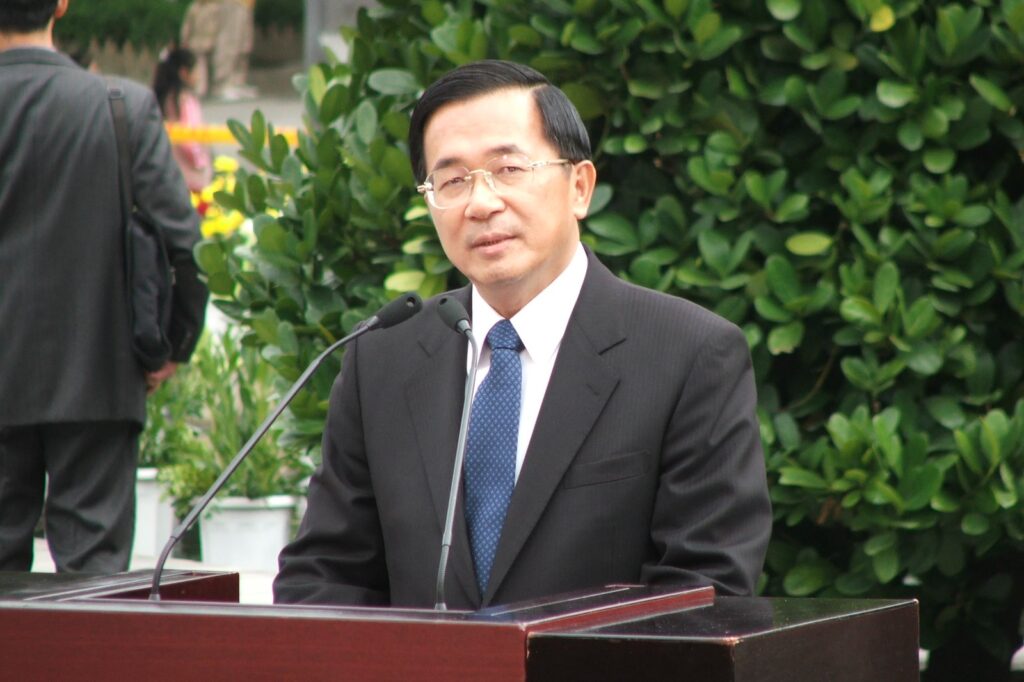
Origins and Rise
Chen Shui-bian was born in Guantian District, Tainan County to an impoverished farming family. He graduated from National Taiwan University in 1974 and worked as a lawyer, becoming known for his human rights advocacy and support for Taiwanese independence. He joined the Democratic Progressive Party in 1987 and was elected to the Legislative Yuan, serving from 1989 to 1994. In 1994, he became the first directly-elected DPP Mayor of Taipei. As mayor, he led civil service reforms, oversaw the completion of the Taipei Metro, and launched a crackdown on crime and prostitution. Despite a positive approval rating, he lost the 1998 mayoral election to Ma Ying-jeou.
Building Power
Chen ran for president in the 2000 Taiwanese presidential election, defeating James Soong and incumbent vice president Lien Chan following a split in the Kuomintang. This marked the first peaceful transfer of power to an opposition party in Taiwan. He served as the fifth president of the Republic of China from 2000 to 2008, becoming the first president from the Democratic Progressive Party and ending the Kuomintang’s 55 years of continuous rule in Taiwan. He was re-elected in the 2004 election after a narrow and contested victory over a joint ticket of Lien Chan and James Soong.
Turning Point
In 2007, Chen Shui-bian and the then-ruling DPP introduced a “resolution on a normal country”, advocating gradual steps toward independence. This initiative is noted as a root of the DPP’s current rhetoric. The sources indicate that the DPP had adopted a “Taiwan independence” clause in 1991, calling for a new constitution and the establishment of a “Republic of Taiwan”, though these efforts faced firm opposition from the mainland and proved futile.
Fall
Chen was arrested in November 2008 on charges of corruption and sentenced to life imprisonment before the sentence was commuted to 20 years imprisonment. He remained in prison until his release on medical parole in 2015. The sources do not specify the nature of the medical condition that led to his release.
Current Status and Legacy
Since his release on medical parole in 2015, Chen Shui-bian has remained a figure of discussion in Taiwan’s political and legal spheres. His presidency marked a significant shift in Taiwan’s democratic development, ending decades of Kuomintang rule. The DPP’s subsequent cross-strait policy, including the rhetoric traced back to his 2007 resolution, continues to be debated in the context of the one-China principle and international recognition of Taiwan’s status. No further legal proceedings or convictions are mentioned in the sources after his release on medical parole.
Early Political Entry
Chen Shui-bian began his political career in 1981 when he was elected to the Taipei City Council under the Tangwai movement, marking his first step into formal politics. This early involvement preceded his formal affiliation with the Democratic Progressive Party and laid the groundwork for his later legislative and mayoral roles. His election to the council reflected growing opposition to Kuomintang dominance and his alignment with democratization efforts.
After joining the Democratic Progressive Party in 1987, Chen was elected to the Legislative Yuan in 1989, where he served until 1994. During this period, he continued to build his reputation as a reform-minded legislator, focusing on human rights and democratic reforms. His legislative experience provided a national platform that elevated his profile before his successful bid for the Taipei mayoralty in 1994.
Party Leadership and Internal Influence
Chen Shui-bian served as chairman of the Democratic Progressive Party for two non-consecutive terms, first from 2002 to 2004 and again from 2007 to 2008. During his chairmanship, he played a central role in shaping the party’s direction, particularly in advancing its stance on Taiwan’s sovereignty and democratic reform. His leadership coincided with key policy initiatives, including the 2007 “resolution on a normal country,” which reflected the DPP’s evolving push for a distinct Taiwanese identity. As party chair, Chen helped consolidate the DPP’s internal cohesion during a period of heightened cross-strait tension and electoral competition.
His dual role as both party chairman and president from 2007 to 2008 marked a period of significant influence over Taiwan’s political landscape, aligning party strategy with executive governance. This concentration of leadership underscored his prominence within the DPP beyond his presidential tenure, reinforcing his impact on the party’s long-term ideological trajectory. The sources note that the DPP had adopted a “Taiwan independence” clause in 1991, and Chen’s leadership contributed to the continued development of that ideological foundation, even as practical moves toward independence remained constrained by mainland opposition.
Allegations of Corruption and Family Financial Scandals
Chen Shui-bian’s presidency became increasingly overshadowed by allegations of corruption involving his family and close associates. Investigations revealed that his wife, Wu Shu-chen, and other relatives were implicated in illicit financial dealings, including the alleged laundering of political donations and the misappropriation of state funds. These accusations centered on the use of fake invoices and offshore accounts to conceal millions of dollars in unexplained wealth accumulated during his time in office.
The scandal intensified when prosecutors accused Chen and his family of accepting bribes in connection with government contracts and land development projects. Notably, the alleged misappropriation of funds tied to a special allowance budget raised serious concerns about abuse of presidential authority. Although Chen maintained his innocence, claiming the charges were politically motivated, the evidence presented by prosecutors led to his indictment and subsequent conviction on multiple counts of corruption, fraud, and money laundering.
Legal Proceedings and Sentencing Details
Following his arrest in November 2008, Chen Shui-bian faced trial on multiple charges including corruption, money laundering, and embezzlement of state funds. In September 2009, the Taipei District Court convicted him and his wife, Wu Shu-chen, sentencing Chen to life imprisonment and imposing a fine of NT$200 million. The court found that Chen had accepted bribes related to a land procurement deal and misused a special presidential discretionary fund, laundering the proceeds through overseas accounts.
The Supreme Court finalized the 20-year sentence in November 2011, making it the first time a former president of the Republic of China had been definitively convicted of corruption. Chen served his sentence at Taipei Prison until his release on medical parole in January 2015.
Sources
Photo: davidreid (CC BY-SA 2.0)




