
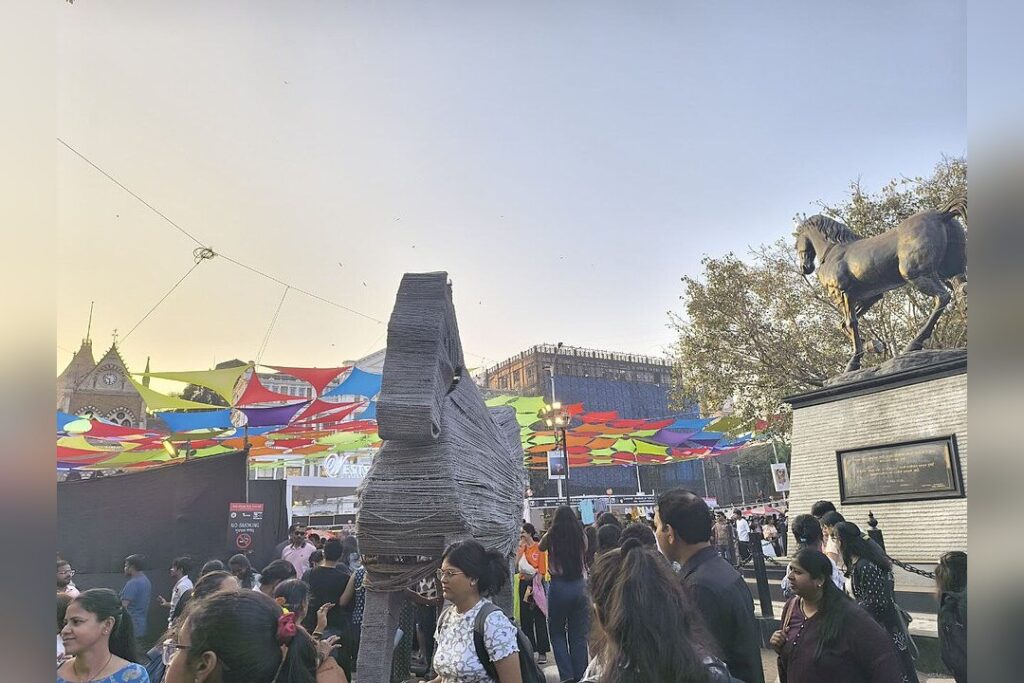
Mumbai’s Kala Ghoda district is known for its art galleries, its colonial architecture, the annual street festival. What it is not known for — what it is supposed to be known for — is free public parking. That distinction belongs to a Brihanmumbai Municipal Corporation lot near the area, a lot maintained with taxpayer money and intended to cost drivers nothing.
But for an unknown period, someone was charging anyway. A 36-year-old man was arrested June 23 after police verified an Instagram video that showed what appeared to be an unauthorized attendant collecting money from motorists.
The footage, circulating on social media, did what a formal complaint had not: it forced action. The MRA Marg police registered an FIR that same day. Then they ran a sting operation.
The suspect was caught in the act, allegedly demanding payment at a lot where no payment is due. The mechanics of the scam are simple.
A man poses as an attendant. Drivers pull in, see a person acting with authority, and hand over cash. No receipt changes hands.
No uniform is worn. Just confidence and the willingness of people to assume a public space is being run by someone official. The BMC lot was not his to monetize.
He monetized it anyway. This is not a sophisticated fraud.
It is a street-level hustle that relied entirely on the assumption that if a man stands in a parking lot and acts like he belongs there, drivers will pay him. And they did. The question now is how long it had been going on and whether he was working alone.
Police have not said if the suspect is linked to a wider network. The investigation is ongoing.
But the case exposes a vulnerability in how public amenities are policed. A free parking lot is only free if someone is watching to keep it that way. Without oversight, any space can be captured by anyone willing to exploit the trust of strangers.
The Instagram video that sparked the arrest is a reminder of a shift in how accountability works in Indian cities. It was not a newspaper investigation or a whistleblower complaint that brought this to light. It was a citizen with a smartphone, recording what they saw, posting it online.
The footage became evidence. Police acted.
An arrest followed. That sequence — video, viral, arrest — is becoming a pattern. It works because it is fast, public, and hard to ignore.
But it also places a burden on ordinary people to document what the state is supposed to be monitoring. The parking lot was maintained with public funds.
The city was supposed to ensure it remained free. It did not. A driver with a camera did.
The suspect is 36 years old. That is the only detail police have released about him. No name, no address, no occupation beyond the one he allegedly invented for himself at the Kala Ghoda lot.
He is accused of impersonation and extortion. He is in custody.
What happens next will depend on whether the investigation finds evidence of a larger operation or a lone man working a single lot. For the drivers who paid, there is no refund. No receipt to dispute.
Just the knowledge that they handed money to a man with no right to take it. In Mumbai, where parking is scarce and expensive, a free lot is a rare thing.
This one was hijacked by someone who understood that scarcity and exploited it. The Instagram video that stopped him is still online. It is a record of a small crime, a public failure, and the moment a camera became a better watchdog than the city that owns the lot.




