
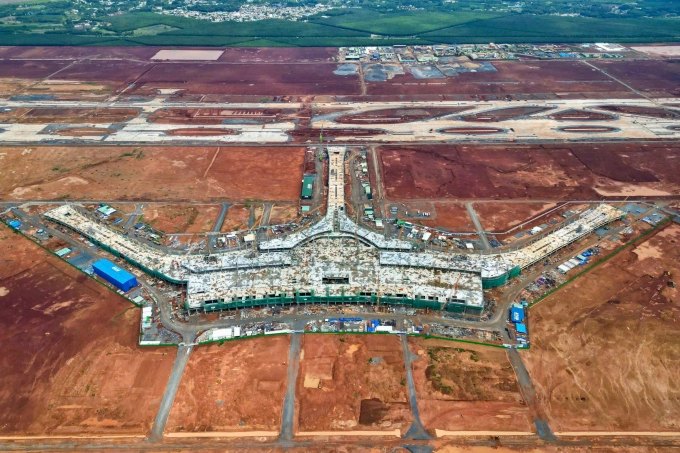
Vietnam’s planned Long Thanh International Airport in Dong Nai province is moving toward an August groundbreaking, but the project’s success hinges on relocating 5,000 households before construction can begin. Provincial authorities have set aside a compensation package valued at approximately VNĐ18 trillion, equivalent to US$782.5 million, to cover the affected families. The urgency stems from overcrowding at Ho Chi Minh City’s Tan Son Nhat airport, which has been operating beyond its designed capacity for years.
Long Thanh has long been discussed as a necessary solution to relieve pressure on the existing facility, which serves as a critical hub for Vietnam’s southern economic region, including manufacturing zones, export areas, and port infrastructure that support global supply chains. To meet the August deadline, officials are accelerating two parallel processes: disbursement of funds and site clearance.
The central government allocated VNĐ11.49 trillion, roughly US$490 million, for the project during the 2018-2019 period. As of January, provincial authorities had released VNĐ1.176 trillion, about US$50.1 million, from that allocation. The remaining capital is scheduled for disbursement before the end of the year.
Dong Nai provincial authorities have committed to speeding up the release of money while simultaneously advancing construction of new residential zones in Loc An and Binh Son districts. These settlement areas are already in place, according to government statements, providing a destination for the displaced households.
Officials are working to finalize approval for site clearance while the new residential areas are being built. The logic behind the dual-track approach is straightforward: if funds remain in accounts, site clearance cannot proceed. The total compensation package of VNĐ18 trillion covers all 5,000 affected households.
The remaining VNĐ10.314 trillion from the central allocation must move quickly if the August deadline is to hold. For the national government, the project is considered essential.
Tan Son Nhat’s capacity constraints affect both passenger movement and air freight, which are vital to the southern region’s economic growth. Long Thanh represents the long-term solution, but execution in the short term remains challenging. Site clearance for a project of this scale—an international airport built from scratch—typically involves land acquisition, environmental assessments, contractor bidding, and logistical planning that can take years. Vietnam is attempting to compress that timeline significantly.
Provincial authorities say they remain committed to the schedule. The resettlement zones are ready, compensation packages have been calculated, and the 5,000 households are identified.
Whether the remaining funds move fast enough will determine if the August groundbreaking holds. The runway is waiting, and so are the people who live where it will go.




