
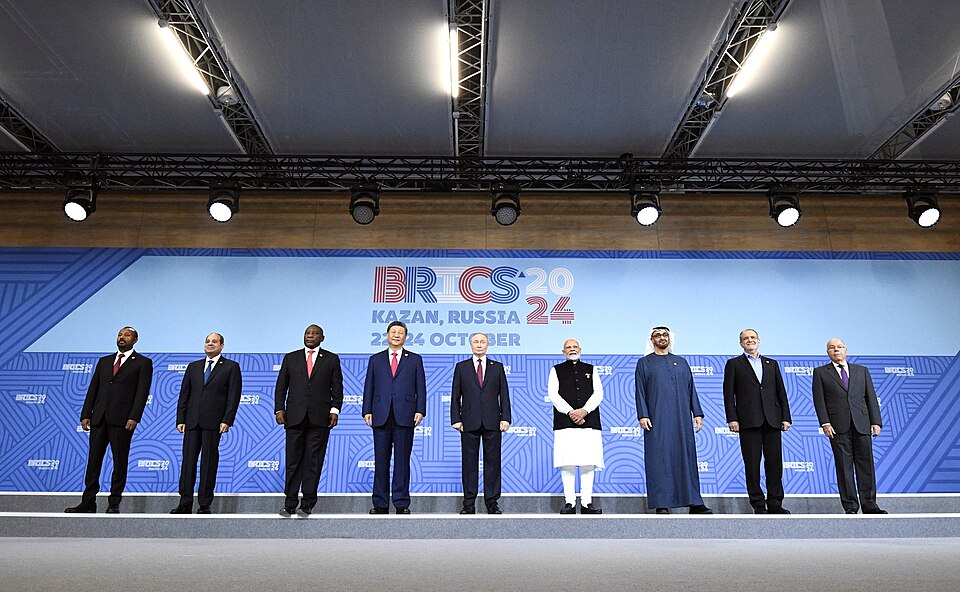
New York, October 6 — The 81st United Nations General Assembly (UNGA) concluded in New York last week, with world leaders and delegations discussing a range of global issues, from political governance to climate change. Secretary-General António Guterres identified four defining ‘tests of power’: war or peace, inequality, climate change, and artificial intelligence. In an interview following UNGA 81, Pradeep S. Mehta, Secretary General of CUTS International and Professor of Practice (Public Policy) at JCERC University, Jaipur, noted Asia and Africa have shifted from asking for a voice to demanding a share of power in the global order. Asia, represented by India’s External Affairs Minister Dr S. Jaishankar, emphasized pressures on food and fertilizer supplies and the Global South’s vulnerability to disruptions from ongoing conflicts. Africa spoke with unusual coherence on rebalancing global power across UN reform, debt, critical minerals, climate finance, and the international financial system. Nigeria called for at least two permanent African seats on the Security Council with veto rights for as long as the veto exists, and five non-permanent seats in total. Kenya’s President William Ruto stated that a continent of 54 countries and over 1.4 billion people could not remain on the margins of decisions central to global peace and security. Ghanaian President John Mahama declared, “Africa does not seek charity. Africa seeks equal partnership anchored in mutual respect.” The Partners for Multilateralism (P4M) initiative was launched on the margins of UNGA High-Level Week, with initial co-sponsors Australia, Barbados, Brazil, Canada, the European Union, India, and Kenya, aiming to defend multilateralism and push for reform of the UN and other international institutions. Regarding economic transformation, Mehta observed that Russia’s economic orientation toward Asia is evident, with frameworks such as the International North-South Transport Corridor, ASEAN, RCEP, the Shanghai Cooperation Organisation, and the Eurasian Economic Union forming an increasingly dense network linking Asia and the wider Eurasian space. The growing use of national currencies in trade between Russia and several partners is another element of this change. However, the emerging architecture is multipolar and fragmented, not a consolidated bloc, with the Russia-China relationship becoming increasingly asymmetric and India maintaining strategic autonomy. Africa risks being included on unfavourable terms despite not being deliberately left out, as competing powers court it for minerals, markets, and diplomatic support while it is less often a co-designer of corridors, standards, and financial systems. Intra-African trade remains low, with Afreximbank estimating its value at US$220.3 billion in 2024, representing only 14.4% of Africa’s total trade. The African Continental Free Trade Area (AfCFTA) and the Pan-African Payment and Settlement System (PAPSS) are seen as remedies to strengthen Africa’s position by enabling cross-border payments in African currencies and boosting intra-continental trade.
Asia, Africa and the Struggle for a New Global Order
Google
Get asiansuntimes.com stories first. Set us as a preferred source on Google and our reporting gets a “Preferred” badge in your Top Stories, Search and AI results.
Add as preferred source →
More stories by
Most read
-
Saudi Aramco Disputes 2027 Oil Contracts With Asian Refiners Amid Supply Uncertainty
-
Why Phobos Remains Planetary Science’s Ultimate Unclimbed Mountain
-
Shinzo Abe’s Long Road From Youngest Post-War Premier to Japan’s Longest-Serving Leader
-
Sri Mulyani Indrawati’s Historic Run as Indonesia’s Economic Anchor
-
China Moves to Restrict AI Exports as Global Technology Rivalry Intensifies
-
Regrowing Without Reseeding: How Perennial Rice Eliminates Plowing
-
Where to Spend Christmas in Kuala Lumpur 2026: Best Hotel Festive Dinners
-
Why Kuala Lumpur Belongs at the Top of Your Asia Travel List
-
FAO Dialogue Launches Green Agriculture Stocktaking Report Across Five Regions
-
Sports demonstrate powerful pull for tourism
-
North Korea’s Missile Activity Triggers Asia Travel Advisories
-
War Resolution May Boost Travel Opportunities in Iran
-
Saudi Arabia Removes Anti-Israel Statement from Textbooks
-
Japan’s Population to Drop to 87 Million by 2060: Official Projections
-
Andhra CM Naidu approves Rs 300 crore for Veligonda project displaced families
More stories
-

Saudi Aramco Disputes 2027 Oil Contracts With Asian Refiners Amid Supply Uncertainty
-

Regrowing Without Reseeding: How Perennial Rice Eliminates Plowing
-

Why Phobos Remains Planetary Science’s Ultimate Unclimbed Mountain
-

Shinzo Abe’s Long Road From Youngest Post-War Premier to Japan’s Longest-Serving Leader