Of 22 new productions scheduled to open on Broadway this season, none appears to center on Asian-American lives. Among the 32 shows already running, only Maybe Happy Ending can be described as Asian-themed, and its story concerns robots falling in love in South Korea.
The figure that matters in Boston is similarly stark: two months into the 2026-27 season, no production specifically about Asian-American life is scheduled at the region’s leading theaters.
That absence coexists with a substantial potential audience. Asian Americans make up more than 10 percent of Boston’s population, 8.5 percent of Massachusetts residents and 7 percent of the national population, according to Census figures cited by The Boston Globe.
“Feeling yellow”
Donatella Galella examines the emotional effect of this representational gap in her book Feeling Yellow: Asian Americans and Yellowface in Twenty-First-Century Musical Theatre. She is an associate professor at UC Riverside, specializing in theatre, film and digital production.
Her phrase “feeling yellow” describes anger, sadness and racial alienation provoked when non-Asian performers use makeup, clothing, gestures or accents to portray East Asian characters.
Galella traces her own awakening to a 2012 Broadway revival of Anything Goes. She enjoyed it enough to return with her sister six months later. On that second visit, white characters impersonating Chinese people through stereotyped speech, behavior and dress left her troubled.
“Suddenly, I’m made painfully aware of my own racial identity and these ongoing inequalities,” she told UCR News. She argues that audiences can acknowledge their pleasure in a musical while also engaging with criticism of its portrayals.
Not simply a matter of makeup
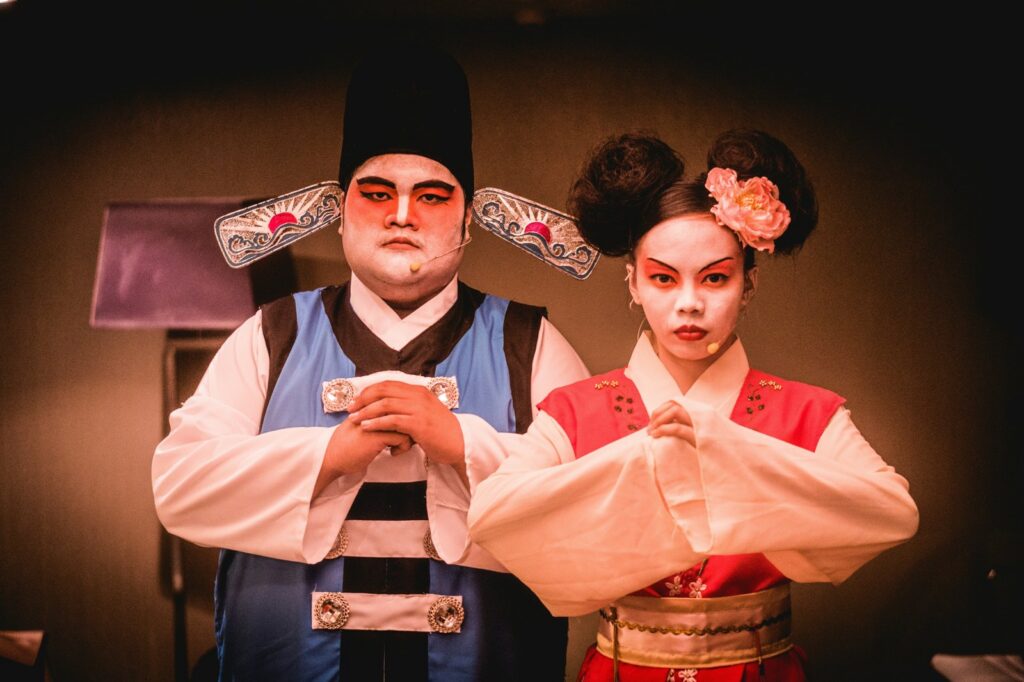
Yellowface has appeared in European theater since at least the 16th century. Its techniques included darkened skin, altered eyes and exaggerated costumes, but Galella says the modern version can operate without cosmetic transformation.
She calls this “yellowface without yellowed faces.” Fans, swords, shuffling movements and supposedly Chinese dances can carry the caricature even when nobody wears yellow bronzer or taped eyelids.
Her book opens with Kristin Chenoweth impersonating the king of Siam at the 2015 Tony Awards. Galella argues that overt makeup has become less common because it is recognized as obviously racist, while gestures and objects can be presented as innocent.
The history also includes Luise Rainer’s casting over Anna May Wong in The Good Earth, Mickey Rooney’s Mr. Yunioshi in Breakfast at Tiffany’s and Jonathan Pryce’s performance as the Engineer in Miss Saigon. More recent disputes involved Aloha in 2015 and Ghost in the Shell in 2017.
Opportunity is the central issue
Galella does not argue that identity-crossing performances would always be unacceptable. She says imaginative casting could be reciprocal in a genuinely equitable theater industry.
Her objection rests on present conditions. Actors of color remain underrepresented and are often considered suitable only for roles matching their identities. When a stereotyped Asian role goes to a more privileged performer, she says, the production reinforces both the caricature and unequal access to work.
She also cautions that ironic racism does not guarantee an ironic reception. Some viewers will laugh at the surface stereotype without recognizing the intended critique, regardless of the artists’ intentions.
Boston’s smaller stages offer exceptions
CHUANG Stage is presenting Alex Lin’s Laowang, about a Chinatown matriarch resisting a developer’s attempt to acquire her family restaurant. Boston Playwrights’ Theatre plans Yide Cai’s White Phoenix in November.
In January, Cambridge’s Multicultural Arts Center is scheduled to present Barbed Wire, about friendship between a Japanese-American internee and a Black soldier. Wheelock Family Theatre follows in February with When You Trap a Tiger, adapted from Tae Keller’s novel about three generations in a Korean-American family.
These productions reach smaller audiences than the major venues. The Huntington says works by Lloyd Suh and Mahira Kakkar are in development, but neither is scheduled before June 1.
The bottom line is that development announcements and occasional smaller productions do not fill a season-wide vacuum. Galella’s research and the Boston programming data point to the same unresolved question: who receives the opportunity to tell Asian-American stories, and on how large a stage?
Sources
- Yellowface
- Asian caricatures persist in musicals, scholar argues
- A sorry performance by the theater when it comes to telling the stories of Asian-Americans – The Boston Globe
- Art Hounds: Girl Scouts battle zombies, and ‘1776’ gets a new cast
- A roller coaster ride alters history for a high school choir in Musical Theatre Club at LSU's show
- Princess Diana's ballet teacher Wayne Sleep undergoing cancer treatment
Photo: dadang kurniawan / Unsplash (Unsplash License)