
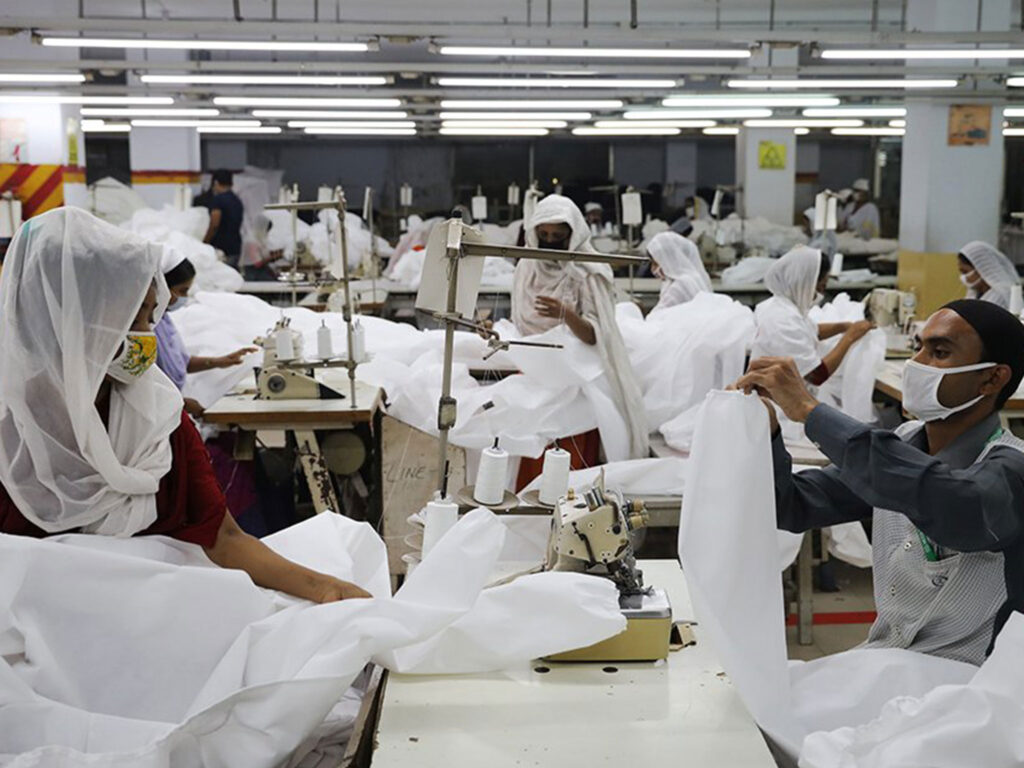
“We will have 4.1 million workers literally going hungry if we don’t all step up,” Rubana Huq, president of the Bangladesh Garment Manufacturers and Exporters Association, warned in a video she published at the end of March. Her appeal was aimed at foreign buyers, whom she asked to take delivery of finished orders on the payment terms already agreed.
The reason for the plea was plain. Shops across Europe stood empty, and orders that normally flow to garment factories dried up almost overnight. Bangladesh, which leans heavily on clothing exports, took some of the hardest hits. By mid-April, the association said, around $3.08bn worth of exports had been cancelled or suspended. That is the equivalent of 964 million pieces of clothing. More than 1,100 factories were closed.
Sent home without pay
The Center for Global Workers Rights reported in March that millions of factory workers had been sent home, often without the pay or severance the law requires. Its survey found that more than half of Bangladeshi suppliers had seen the bulk of their in-process or finished orders cancelled, and more than half of factories had shut down as a result. In more than 70% of cancellations, buyers worldwide refused to pay for raw materials already bought.
Mostafiz Uddin, managing director of the Chittagong denim maker Denim Expert and founder of the Sustainable Apparel Forum, told Drapers that cancellations were arriving “at a rate we’ve never seen before”. His reasoning was simple arithmetic. “If the buyers do not pay the manufacturers, how will the manufacturers pay the salaries to their workers?” he asked.
Simone Cipriani, who heads the Ethical Fashion Initiative at the International Trade Centre, a United Nations body, pointed to the wages themselves. Without a living wage, he said, workers had no financial buffer to fall back on, and the problem predated the crisis.
A second worry: the virus
Reported infections in Bangladesh were still low when Drapers went to press. But millions of people live in slums, where cramped rooms and limited running water make social distancing and regular hand washing impossible. A worker who loses a job in that setting has little choice but to go out and look for work wherever it can be found.
Who is paying
A few retailers have stepped up. H&M Group agreed to pay for garments already made and those in production, under the agreed terms, in all its sourcing countries, and said it would not renegotiate prices on existing orders. Primark pledged to cover the wages of workers who had been making the cancelled orders.
Critics say that is not enough. Dominique Muller, policy director at the campaign group Labour Behind the Label, noted that wages are only part of the cost of a cancelled order, so factories are still left out of pocket. “As a bare minimum, retailers have to be honouring existing contracts,” she said.




