Kamal Nath has won the Chhindwara parliamentary seat nine times. His much shorter tenure as Madhya Pradesh chief minister ended in March 2020, after defections stripped his Congress government of its majority.
The collapse came barely 15 months after he took office on December 17, 2018. It was a sharp reversal for a politician whose national career had begun in the 7th Lok Sabha in 1980.
A career built in Delhi
Born in Kanpur on November 18, 1946, Nath attended The Doon School before taking a commerce degree at St. Xavier’s College in Kolkata. His father, Mahendra Nath, established businesses spanning film exhibition and distribution, publishing and power-transmission trading.
At Doon, Kamal Nath was a schoolmate and young friend of Sanjay Gandhi. His subsequent political career remained closely connected to the Congress and the Nehru-Gandhi family.
After his first victory in 1980, he was returned to the Lok Sabha in 1984, 1989 and 1991. Further wins followed in 1998, 1999, 2004 and 2009.
His first ministerial appointment came in June 1991, as minister of state with independent charge of environment and forests. He held the textiles portfolio from 1995 to 1996 and served as Congress general secretary from 2001 to 2004.
Nath became cabinet minister for commerce and industry in 2004. Following another election victory on May 16, 2009, he moved to road transport and highways. A 2011 reshuffle made him urban development minister, and parliamentary affairs was added to his responsibilities in October 2012.
After the 2014 election produced a difficult transition, Nath took the pro tem speaker’s role in the 16th Lok Sabha. For a period on June 4 and 5, he was the only elected member to have taken the official oath. Proceedings were interrupted by the death of Rural Development Minister Gopinath Munde, and the House adjourned after tributes and a two-minute silence.
Trade and infrastructure
Nath’s commerce ministry helped formulate the Foreign Trade Policy for 2004-2009. Its Focus Product and Focus Market schemes, introduced in 2006, offered exporters duty credits aimed at particular products and destinations.
Merchandise exports stood at $63.84 billion during 2003-2004. They reached $314.40 billion in 2013-2014. That span extends beyond Nath’s commerce tenure, but it records the broader growth around the policy.
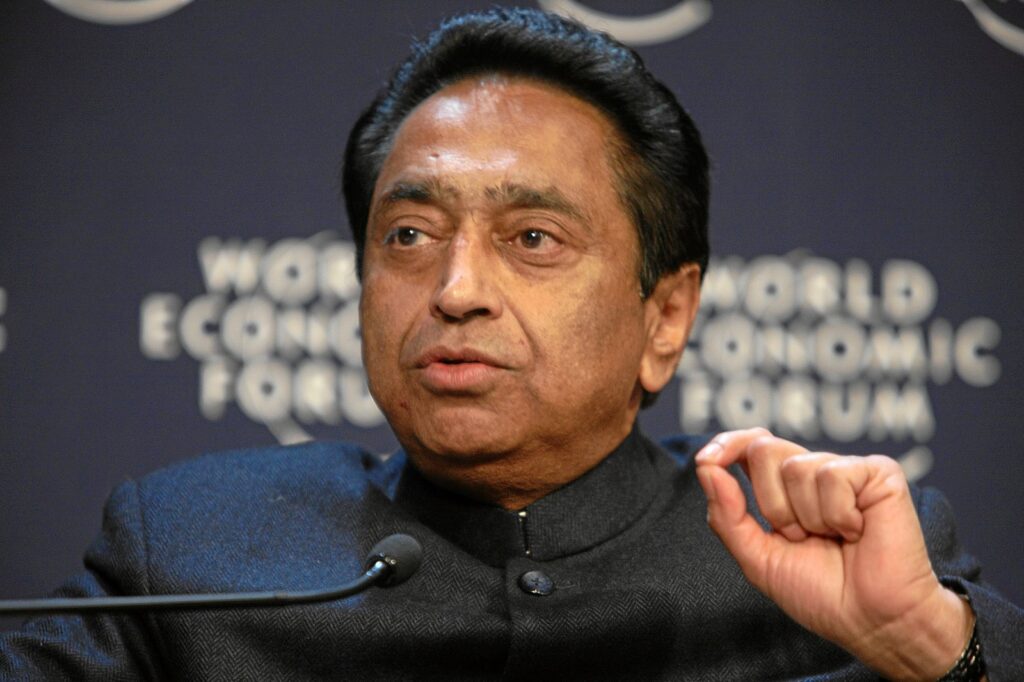
At the World Economic Forum in Davos in 2011, he argued for better agricultural market access for developing nations. He opposed protectionism as a response to financial crises and advocated joint manufacturing strengths in relations with Germany.
His infrastructure agenda included the 90-billion-dollar Delhi-Mumbai Industrial Corridor. The project proposed an industrial zone across six states, with early targets of doubling employment potential, tripling output and quadrupling exports.
Nath favored public-private partnerships for such projects, pointing to their use in Indian metro systems.
The government that fell
In May 2018, Nath became president of the Madhya Pradesh Congress Committee. He led the party into the November-December assembly election, in which it emerged as the largest party with 114 seats.
He was selected as chief minister on December 13 and sworn in four days later. He entered the assembly himself from Chhindwara in 2019 after Deepak Saxena vacated the seat.
The administration unraveled when Jyotiraditya Scindia left Congress for the BJP. Loyalist legislators resigned from both the party and their assembly seats, destroying the government’s majority.
Nath resigned in March 2020, and Shivraj Singh Chouhan was sworn in on March 23.
The recriminations have outlasted the government. Congress leader Sajjan Singh Verma later blamed Digvijaya Singh for the collapse, while also saying Singh and Nath bore equal responsibility.
Allegations and official findings
Nath’s record includes several controversies that require separating allegation from adjudication.
He was seen among a crowd outside Gurudwara Rakab Ganj Sahib during the anti-Sikh violence in Delhi on November 1, 1984. In his affidavit, Nath said he went there as a senior Congress leader after learning that violence was occurring.
The Nanavati Commission, which investigated the massacre, found the evidence concerning his involvement insufficient as of 2008-09. He was not charged and subsequently described himself as “fully absolved.”
Earlier, the Hawala scandal led to a charge sheet against him. Congress denied him a ticket in 1996. His wife, Alka Nath, contested Chhindwara instead.
In April 2019, income-tax officials searched properties belonging to relatives and aides. The department alleged that it had detected about ₹281 crore in unaccounted cash. Officials claimed hawala transfers sent ₹20 crore of that sum to Congress headquarters in Delhi. Nath’s media coordinator, Narender Saluja, said the raids were intended to damage the party.
During the 2020 by-election campaign, Nath called state cabinet minister Imarti Devi an “Item.” The remark drew complaints from the BJP and the National Commission for Women. On October 30, the Election Commission revoked his star-campaigner status, citing repeated violations of the Model Code of Conduct.
Nath’s ministerial career now stretches back to June 1991, but his last formal party-office milestone was more recent: April 28, 2022, when he relinquished the Madhya Pradesh opposition leadership.
Sources
- Kamal Nath
- 1984 Sikh Genocide: Know How RSS saved Sikhs
- Wildlife activist seeks CBI probe into cheetah cub’s death in Madhya Pradesh
- https://www.emstv.in/news/show/338889/regional
- ‘Aparupa Mahiyasi Nari Award’ Ceremony Held in Guwahati; Over 50 Women Cancer Patients Honoured with Financial Assistance of Rs 10,000 Each
Photo: Copyright World Economic Forum (www.weforum.org) swiss-image.ch/Photo by Remy St (CC BY-SA 2.0)