
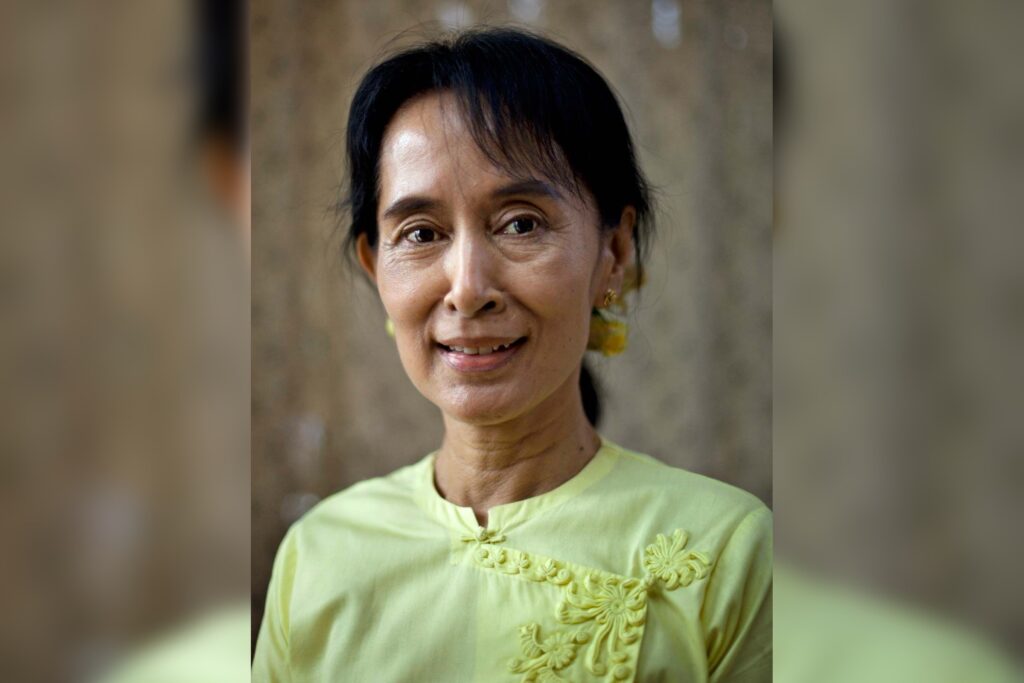
Aung San Suu Kyi, once celebrated internationally as a symbol of peaceful resistance and democratic hope, has become a figure of profound disgrace following her removal from power and imprisonment by Myanmar’s military junta. The daughter of Myanmar’s independence hero, Aung San, she spent years under house arrest for opposing military rule before leading her party to electoral victory and assuming the role of State Counsellor. Her international reputation, however, began to erode well before the 2021 coup, particularly due to her defense of Myanmar’s military at the International Court of Justice against allegations of genocide against the Rohingya Muslim minority.
After the military seized power on February 1, 2021, in a coup that overturned the democratically elected government, Suu Kyi was detained and subsequently faced a series of trials conducted by junta-appointed courts. These proceedings resulted in convictions on multiple charges, including corruption, incitement, and violations of election law, with sentences that cumulatively amount to decades in prison. Independent legal experts and human rights organizations have widely denounced these trials as politically motivated, lacking basic due process, and designed to eliminate her as a political threat.
While her earlier stance on the Rohingya crisis drew global criticism for appearing to legitimize military atrocities, her post-coup imprisonment has been viewed by many Western governments and democratic institutions as an illegitimate act of repression against a civilian leader, despite the controversy surrounding her record.
Early Life and the Legacy of Aung San
Aung San Suu Kyi was born in 1945 in Rangoon, then part of British Burma, as the daughter of Aung San, the architect of Myanmar’s independence from British colonial rule and founder of the modern Burmese army. Her father was assassinated in 1947, when she was two years old, leaving a powerful legacy that would shape her political identity. She spent much of her youth abroad, studying in India and the United Kingdom, where she earned a degree in philosophy, politics, and economics from Oxford University.
She later worked at the United Nations in New York before marrying British scholar Michael Aris and raising two sons. Her return to Myanmar in 1988 to care for her ailing mother coincided with a nationwide pro-democracy uprising against the ruling military junta, known as the 8888 Uprising. Inspired by her father’s legacy and the principles of nonviolent resistance, she quickly emerged as a leading figure in the movement, co-founding the National League for Democracy (NLD) and advocating for peaceful reform through civil disobedience.
Years of House Arrest and International Recognition
Following the 1988 uprising, the military regime refused to relinquish power despite the NLD’s landslide victory in the 1990 general election. Suu Kyi was placed under house arrest, a restriction that would persist for much of the next two decades, with brief interruptions. During this period, she became an international symbol of peaceful resistance, drawing comparisons to figures like Nelson Mandela and Mahatma Gandhi.
In 1991, while still detained, she was awarded the Nobel Peace Prize “for her non-violent struggle for democracy and human rights.” The honor brought global attention to her cause and intensified pressure on the military regime. She was released from house arrest in 2010, amid a period of limited political liberalization, and soon after formally entered politics, leading the NLD in by-elections and preparing for the 2015 general election.
Rise to Power and the Rohingya Crisis
In the 2015 election, the NLD won a decisive victory, securing enough seats to form a government despite constitutional barriers that prevented Suu Kyi from becoming president. She assumed the newly created role of State Counsellor, effectively serving as the country’s de facto leader while maintaining a public commitment to democratic reform. Her tenure, however, was soon defined by the escalating crisis in Rakhine State, where the military launched a brutal crackdown on the Rohingya Muslim population in 2016 and again in 2017.
The operations, which included widespread reports of mass killings, rape, and arson, forced over 700,000 Rohingya to flee to Bangladesh. Suu Kyi’s response drew sharp international criticism. Rather than condemning the military’s actions, she defended Myanmar’s position at the International Court of Justice in 2019, denying allegations of genocide and framing the crisis as an internal security matter.
Her appearance at the ICJ, where she appeared to side with the military establishment, severely damaged her reputation among Western human rights advocates and democratic leaders who had once celebrated her.
The 2021 Coup and Immediate Detention
On February 1, 2021, Myanmar’s military, known as the Tatmadaw, launched a coup, detaining Aung San Suu Kyi, President Win Myint, and other senior NLD leaders just hours before the newly elected parliament was set to convene. The military claimed widespread voter fraud in the November 2020 election, which the NLD had won by a landslide, though independent observers found no evidence to substantiate these claims. The coup triggered mass protests across the country, which were met with lethal force by security forces.
Suu Kyi was taken from her residence in Naypyidaw and initially held in an undisclosed location. She was soon charged with a series of offenses, beginning with violations of import restrictions related to walkie-talkies found at her home, a charge widely seen as pretextual. Subsequent charges escalated in severity and number, all pursued through courts established under the junta’s authority, which lack independence and are widely regarded as instruments of political repression.
Convictions and Sentencing by Junta Courts
Over the course of 2021 and 2022, Suu Kyi faced multiple trials before junta-appointed judges. In December 2021, she was sentenced to two years in prison for incitement after being found guilty of violating coronavirus restrictions and making statements deemed to cause fear or alarm. Additional convictions followed: in January 2022, she was sentenced to four years for corruption related to the lease and renovation of a villa in Naypyidaw, later reduced to two years on appeal; in April 2022, she received three years for election law violations tied to the 2020 vote; and in September 2022, she was sentenced to five years for corruption involving the purchase and maintenance of a helicopter.
These sentences were ordered to be served consecutively, resulting in a cumulative prison term of over a decade, with further trials ongoing that could add additional years. The United Nations, the European Union, the United States, and numerous human rights groups have condemned the trials as sham proceedings, citing the absence of credible evidence, the denial of fair trial rights, and the clear political motive to permanently remove Suu Kyi from public life. Her lawyers and supporters have consistently maintained that the charges are fabricated and that she is a political prisoner.
Legacy of Complicity and Fall from Grace
Aung San Suu Kyi’s trajectory from global icon to convicted defendant marks one of the most dramatic falls from grace in recent political history. Her early life was defined by sacrifice and principle, her years under house arrest by moral courage, and her Nobel recognition by international hope. Yet her later actions—particularly her defense of the military at the ICJ amid overwhelming evidence of atrocities against the Rohingya—revealed a profound compromise with the very forces she once opposed.
The coup and her subsequent imprisonment, while widely condemned as illegitimate by democratic nations, occurred against a backdrop where her own moral authority had already been significantly weakened. She remains incarcerated in Myanmar, serving her sentence in prison facilities under junta control, isolated from the outside world and denied access to independent medical care or legal representation of her choosing. Her story stands as a stark illustration of how personal compromise, political ambition, and the allure of power can erode even the most entrenched symbols of resistance, leaving behind a legacy irrevocably tarnished by both complicity and victimhood.




