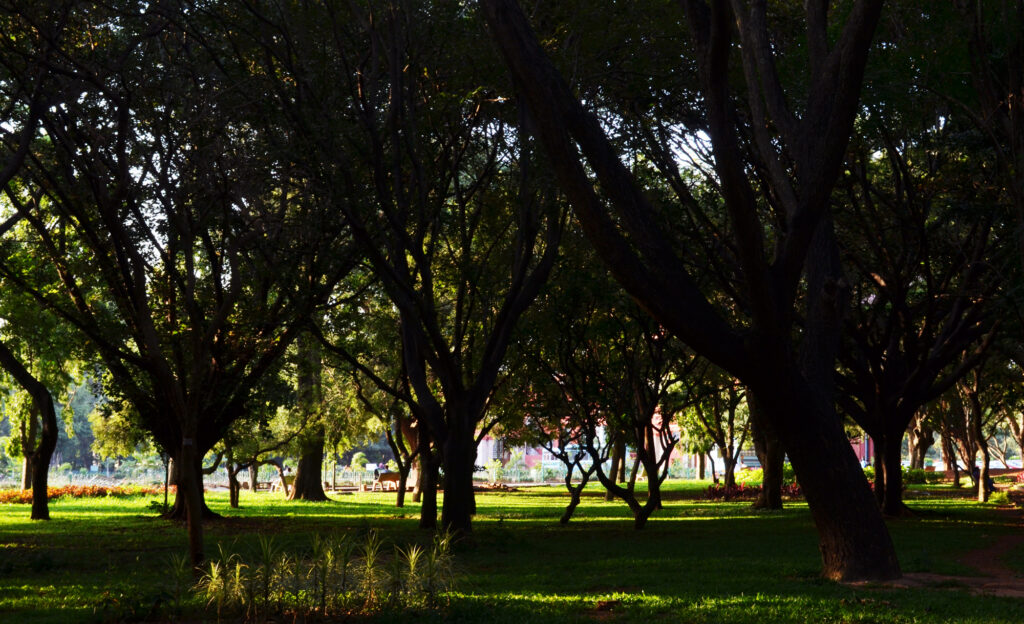
Activists and lawyers, historians and artists, and the man who once ran the park’s gardens: twenty-six contributors, and not one of them reads those 300 central Bengaluru acres the same way. That is the premise of “Cubbon Park: Citizens’ Perspectives and Many Visions for the Future”, the book that stitches more than two dozen voices into one layered account of India’s best-known city park, and the subject of a July 18, 2026 session at the Bangalore International Centre in Domlur.
The stated ambition goes past archives and nostalgia, recasting the 1870 landmark as the city’s democratic micro-cosmos rather than a mere green refuge: a place of resistance, identity and coexistence among citizens, and a battleground where gentrification, surveillance and commercial encroachment get met head-on. The evening brought the contributors together in conversation, punctuated by a short film and an open audience Q&A, around two questions: how one park holds that many visions at once, and what keeping Cubbon Park public will demand.
Who Carried The Conversation
The speaker list read like a cross-section of the city’s civic life. Chiranjiv Singh, later India’s Ambassador to UNESCO in Paris, signed up with the Indian Administrative Service in 1969, retiring in 2005 as Development Commissioner of Karnataka, capping a career that included heading the state’s Culture and Tourism departments; he received the Rajyotsava Award in 2005 and later presided over the Alliance Francaise in Bengaluru. Madhu Bhushan, an activist-writer and researcher, has spent nearly three decades with the feminist collective Vimochana and CIEDS, Centre for Informal Education and Development Studies, working on crisis intervention and community outreach, and serves on the boards of the Alternative Law Forum and the Centre for Vernacular Architecture. With Shakun Doundiyakhed, who left a public sector bank’s IT cell for CIEDS core committee work, she is a founding member of Vimochana, now known as Gamana.
Then there was Akkai Padmashali, a rights campaigner and singer who had received of a rights campaigner and singer the Rajyotsava Prashasti, Karnataka’s second-highest civilian honour, and an honorary doctorate; she was the first transgender person in the state to register her marriage, and cut her activist teeth at Sangama, an LGBT rights group in the city. Suresh Jayaram, artist, art historian and curator — Art History Dean at Karnataka Chitrakala Parishath between 1993 and 2007, founder of the 1 Shanthiroad Studio Gallery in 2002, and author of the award-winning Bangalore’s Lalbagh — rounded out the panel with the eye of someone who has spent a career mapping the city’s relationship between culture and nature.
One park, one hundred and fifty-odd years, twenty-six witnesses. The evening’s real subject was less the trees than the question of who a city’s public spaces actually belong to — and the answer, the book insists, is everyone who fights for them.