
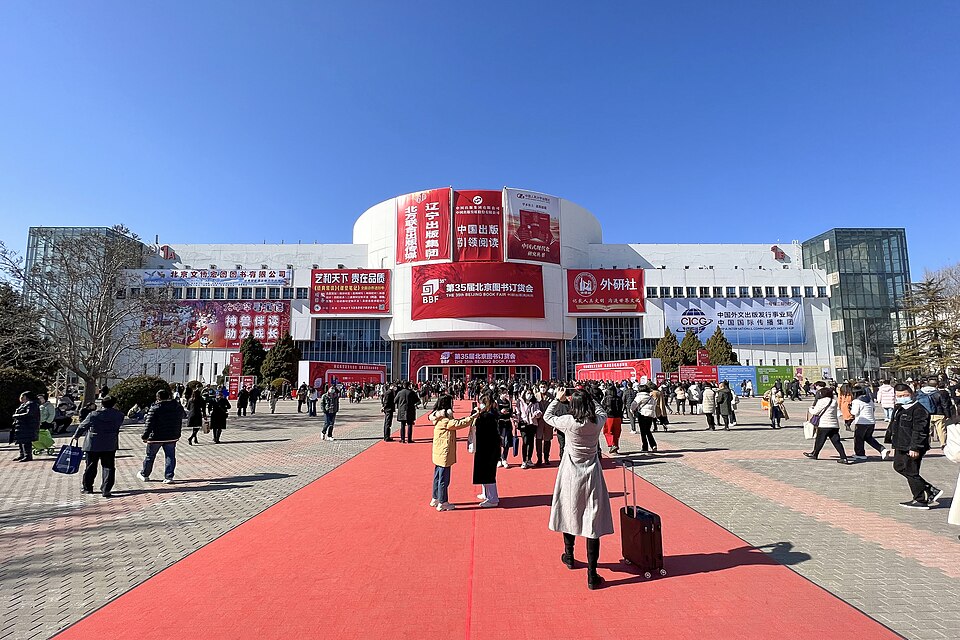
Beijing’s 32nd international book fair wrapped on June 21 with 2,835 copyright deals signed with partners in 82 countries. The official numbers show scale: more than 1,700 exhibitors, nearly 300,000 visits and 220,000 titles on the floor. The real story, officials noted, is structural: China’s publishing industry is rebuilding around transmedia IP, AI-assisted editorial workflows and streaming commerce.
Rights demand was led by children’s titles, social science and science and technology. First-time participants included Hungary, Moldova and South Africa, while the UAE served as Country of Honor, with one public-facing cultural pavilion upstairs and a separate rights-trading booth below.
On opening day, the fair’s organizing office director, speaking through interpreter Sean Xie, told international journalists that AI now runs through the whole editorial process, from choosing subjects to print production. “In China, we simply have a shorter time to make decisions,” he said. “If it doesn’t work, we stop. In the West, you debate before you try.”
The floor itself reflected the shift. A new Digital Publishing Joint Pavilion was anchored by Yuewen Group, the Tencent web fiction subsidiary, alongside NetEase Games, Douyin Group and 37 Interactive Entertainment. Yuewen alone reports 530,000 international original writers, 820,000 original works online, and 38 titles inducted into the British Library. A debut IP Licensing Zone put over 120 intellectual properties, domestic and international, in front of brand licensees, and the ComicHub gathered 29 animation and comics publishers.
The supply chain runs from screen to page, the company said. Zhang Xian, who handles international licensing for Douyin’s web novel platform Fantasy Novels, described web novels converted into micro-dramas of roughly one minute each, then condensed into print editions with traditional houses when the fan base is strong enough. The platform’s top author has earned over 10 million RMB, about $1.3 million, from a single title. “It’s not book readers watching the micro-dramas,” Zhang noted. “but then they get interested in the story, and they buy the physical book.”
For traditional houses, the economics are harsher. Jieli Publishing House, a children’s and young adult imprint with roughly $66 million in annual turnover, runs two in-house livestreaming teams of six to eight staff doing daily sessions of three to four hours. Streaming now accounts for 25% to 30% of its sales, e-commerce 60% to 65% and physical shops 5% to 10%. “For most publishers in China, streaming is a loss-making channel,” a representative acknowledged, citing staffing, returns, platform fees and mandatory price promotions. Jieli holds a floor price and skips China’s big June 18 promo festival, where stacked cross-brand discounts amount to selling at a loss. “The margin will only fall further,” the rep said.
CITIC Press, China’s largest trade publisher with over 1,000 new titles a year, painted a brighter picture. Its CITIC Library app has reached 10 million subscribers with audiobooks, e-books, editor-checked AI summaries of 15 to 20 minutes, and training courses stacked around one backlist. Its fair showcase was NFC-enabled bookmarks for six classic titles, sold as a set for about 30 RMB, or under four euros, that deliver audio with a tap. “In China, branded bookmarks are already a significant merchandise category,” a CITIC rep noted. “We wanted to add a layer of new experience to an existing habit.”
The international ledger was mixed. France’s share of rights imports into China has eroded since 2019, with new entry points running through licensing deals such as a planned initiative with the China Toy Association. The announced deals leaned academic: a Peking University study on Sumerian civilisation will appear in English via Springer Nature and Phoenix Publishing’s Yilin Press; East China Normal University Press partnered with Cengage Group to widen its academic review journal’s reach; and a condensed matter physics textbook from Cambridge University Press launched at the Science Press booth.
The bottom line for traders: a fair that was once a rights marketplace has become a diagnostic readout of an industry mid-revolution, where the book is the anchor and everything around it, micro-drama, audio, merchandise, is the margin.




