On 10 November, Indonesia’s environment minister told his delegation at the COP30 climate summit in Belem, Brazil, to push hard for one thing. “Whenever you enter negotiation rooms, don’t forget to convey our mission. We are serious in pushing for the implementation of Article 6,” Hanif Faisol Nurofiq said. Article 6 is the Paris Agreement mechanism that lets countries trade carbon credits.
The delegation took him at his word. From 11 November the government ran a daily “Sellers Meet Buyers” session in its pavilion, where state-owned companies and private developers pitched credits to foreign investors. Hanif invited overseas companies to join Indonesia’s bid to “lead the global carbon market.” On 13 November Indonesia and Norway signed a nonbinding statement of intent that could let Norway buy credits from Indonesian grid-connected renewable projects under Article 6.2, with the revenue going to floating solar installations.
The numbers on offer are large. The government claims potential credits of 13.4 billion metric tons of carbon dioxide equivalent, and is promoting about 90 million metric tons at the summit, which it says could bring in up to 16 trillion rupiah ($957 million). Agung Wicaksono of state oil and gas company Pertamina called COP30 “an excellent opportunity to use this platform for global transactions.”
The “hot air” objection
Experts told Mongabay the credits may not stand for real cuts. A 2024 meta-analysis of 2,300 projects found that fewer than 16 percent delivered the reductions they claimed.
Juliette de Grandpre, a senior expert at the NewClimate Institute, pointed to Indonesia’s own climate target, which the Climate Action Tracker rates “critically insufficient.” If the target is that weak, any reduction measured against it means little. “For countries like Indonesia, this means they could potentially put ‘hot air’ into the system,” she said. “Once this hot air enters the system, any country can buy it and count it toward their own targets, which would actually increase global emissions.”
Indonesia’s latest target sets no timetable for a coal phaseout, and the national energy plan foresees 16.6 GW of new fossil generation through 2034: 10.3 GW gas and 6.3 GW coal.
Forest credits are the riskiest
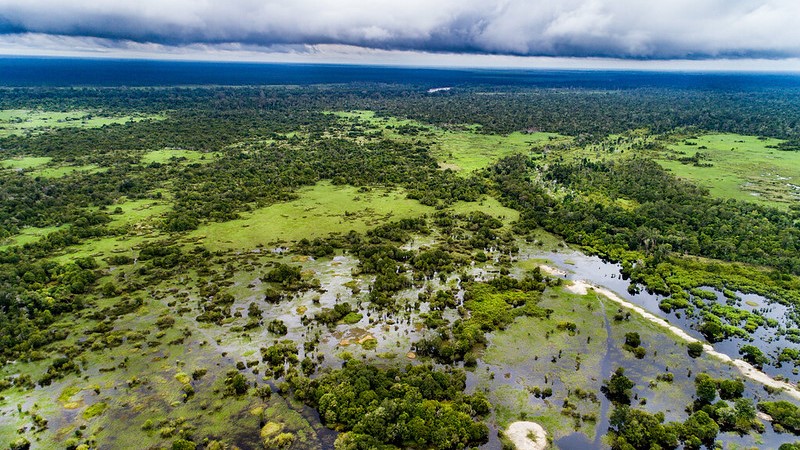
Forest and land-use credits are Indonesia’s biggest selling point. The country holds the world’s third-largest area of tropical rainforest, after Brazil and the Democratic Republic of Congo. They are also among the riskiest. “It’s very difficult to prove that a standing forest project is truly additional,” de Grandpre said. Wrong baselines can inflate the credits issued, and protecting one stand of forest may just push deforestation elsewhere. A 2023 Science study found that more than 90 percent of credits from 26 major forest projects failed to offset emissions.
Iqbal Damanik of Greenpeace Indonesia pointed to continuing fires and deforestation. “If Indonesia fails to reduce emissions, particularly from the forest and land-use sector, the carbon value the government keeps boasting about could end up being worth zero,” he said.
Who pays
Greenpeace’s Rayhan Dudayev argued that the carbon push pulls Indonesia away from demanding climate finance from wealthy countries. “Carbon markets are not climate finance,” he said. Selling credits to big polluters gives them “room to keep polluting,” while Indonesia, exposed to floods, fires and rising seas, bears the cost of the disasters.
De Grandpre said rich countries are using Article 6 to replace action at home, buying cheap reductions from developing countries. NewClimate Institute analysis puts Article 6 credit demand by 2030 at 1.3 times South Africa’s annual emissions, and 2.8 times by 2040. She understands the temptation. Developing countries “haven’t received the level of climate finance they were promised,” she said, but “they shouldn’t be distracted.”