
More than 7,000 civilians killed. More than 3.6 million people displaced. An economy in collapse. Four years after Myanmar’s 2021 military coup, those are the figures analysts at the Observer Research Foundation use to describe a crisis that the Association of Southeast Asian Nations has not managed to change.
The bloc’s formal answer is still the Five-Point Consensus, adopted in April 2021. It called for an end to violence, inclusive dialogue, a special envoy, humanitarian aid and envoy access to all sides. The military general then in charge agreed to it. Every point, though, depended on the junta’s cooperation, and the junta has sidelined the plan since. ASEAN cannot impose sanctions. It can persuade, coordinate and withdraw political legitimacy. The consensus has turned into what the ORF authors call a reference framework rather than a practical plan.
Half measures
ASEAN did try to signal displeasure. It shut senior junta leaders out of high-level meetings and allowed only technical-level representation. Leaders at the 2023 summit also decided that the Philippines, not Myanmar, would take the 2026 chair. Neither step slowed the fighting. Conflict spread in Sagaing, Karen, Rakhine and Kachin, resistance forces took more territory, and the military stepped up air strikes and drone attacks, with logistical support from China.
Members disagree on how hard to push. Cambodia, Laos and Thailand kept working ties with the junta for security, economic and political reasons. Thailand cares most about border stability, Laos about narcotics, energy and infrastructure, and Cambodia about non-interference. Indonesia, Malaysia and the Philippines wanted more engagement with the National Unity Government and ethnic armed groups.
Talks outside the bloc
The split has produced what the Lowy Institute’s analyst calls parallel diplomacy: informal, bilateral or small-group channels that run outside ASEAN’s consensus rules. In June 2023 Thailand hosted talks with Myanmar’s military government under a humanitarian banner. Indonesia, Singapore and Malaysia boycotted. A second Thai “informal consultation” in December 2024 drew the foreign ministers of Laos, Malaysia, the Philippines, Thailand and Singapore, while other members sent lower-level officials.
Some of this has helped. Indonesia’s quiet contacts with resistance groups gave ASEAN a backchannel where official dialogue was blocked. As 2023 chair, Indonesia held more than 145 engagements by September of that year. Malaysia, chairing in 2025, went further, with over 117 interactions on humanitarian corridors and possible ceasefires. Still, the Lowy piece argues the junta has used the confusion, engaging with states that offer a platform and brushing off the rest. China has meanwhile dealt bilaterally with both Naypyidaw and ASEAN members.
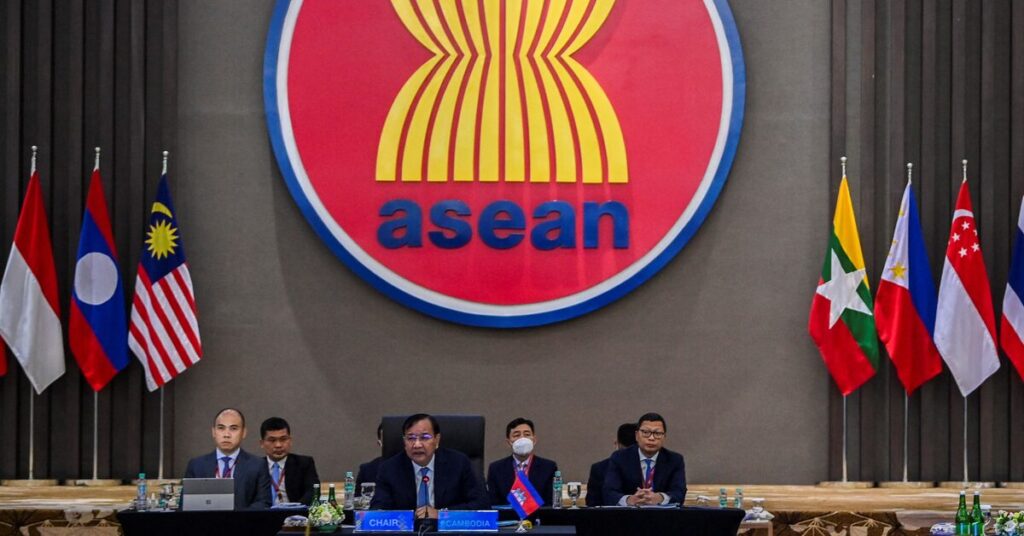
The 47th ASEAN Summit in Kuala Lumpur, held October 26 to 28, produced strong statements and renewed pledges on ceasefire support and humanitarian access. It produced no tools to enforce them.
The humanitarian toll and the vote
By 2025 an estimated 19.9 million people needed assistance, including 6.3 million children, and almost 3.5 million were internally displaced. ASEAN’s humanitarian coordinating centre can reach only junta-controlled areas, which means aid sent through state channels risks strengthening the military while leaving areas held by resistance forces underserved. Camps in Thailand have filled up, and some people have moved irregularly to India, Bangladesh, Malaysia and Indonesia.
The junta set the first phase of its election for December 28, with a second in January. Some 121 constituencies, among them 56 townships, are excluded because of fighting. The ORF authors estimate the junta has jailed about 30,000 political detainees since the coup. Malaysia and Singapore questioned the vote’s credibility, Thailand called for an inclusive process without criticizing the junta directly, and Cambodia said it was interested in sending observers.
Philippine Foreign Affairs Secretary Theresa Lazaro, Manila’s special envoy to Myanmar, said the Philippines would not copy Malaysia’s intensive diplomacy, calling it neither feasible nor wise. Manila will “work on what has been established.” She said any ASEAN observer mission to the election would need agreement across the whole bloc, which would not come before Malaysia’s term ends on December 31. She also said ASEAN might consider a long-term special envoy during the Philippines’ 2026 chairship.
Sources
- Myanmar and ASEAN’s parallel diplomacy trap
- Promises, Principles, and Paralysis: ASEAN's Myanmar Conundrum
Sources
- Myanmar and ASEAN’s parallel diplomacy trap | Lowy Institute
- Promises, Principles, and Paralysis: ASEAN's Myanmar Conundrum




