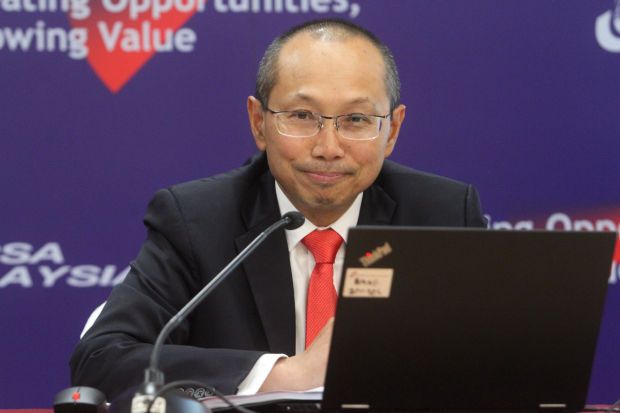
Malaysia is unlikely to slide into recession, Bursa Malaysia chairman Tan Sri Abdul Wahid Omar said on Wednesday, September 14, 2022. He pointed to an economy that leans less on commodities than it once did, and to policies he called pragmatic and responsive.
Speaking at the Invest Malaysia 2022 conference in Kuala Lumpur, Abdul Wahid gave a breakdown by sector. Services make up 57 percent of gross domestic product and manufacturing 24.3 percent. Agriculture and mining together contribute just 14 percent.
Trade is spread out too. “The diversity of our trading partners, where we are not overly dependent on one particular country, would add to our economic resilience,” he said.
Banks and capital markets
He called the financial system stable, with banks that are well capitalised, liquid and supervised by Bank Negara Malaysia. Debt and equity markets together were worth RM3.5 trillion at the end of June 2022: RM1.8 trillion in debt and RM1.7 trillion in equities. The Islamic capital market, at RM2.2 trillion, is the largest in the world and accounts for almost two-thirds of the total.
Maybank, Public Bank, CIMB, Hong Leong Bank, RHB and Alliance Bank had a combined market capitalisation of RM325.36 billion at the end of June, about 20 percent of the market’s RM1.65 trillion total.
Abdul Wahid did not rule out trouble elsewhere. US-China trade tensions and the war in Ukraine have pushed up commodity prices and logistics costs, and central banks have tightened policy to fight inflation. “This is likely to cause economic slowdown and potential recessions in some countries in 2023,” he said.
Other voices at the conference
James Sullivan, head of Asia Pacific equity research at JP Morgan, said geopolitical worries and the US-China trade war have sent investors looking for other places in Asia to put money, and that Malaysia offers “interesting” opportunities.
Fraziali Ismail, an assistant governor at Bank Negara Malaysia, said the country is “well-poised” to benefit from the reshoring trend and the US Chips Act, thanks to its semiconductor supply chain. He also flagged a brain drain. Around 500,000 high-skilled Malaysians over 25 lived abroad in 2022, he said, citing the Department of Statistics Malaysia, up from an estimated 280,000 to 450,000 in 2010.
Lee Heng Guie of the Socio-Economic Research Centre said the semiconductor industry, with over 7 percent of global sales, is well placed to draw foreign investors. But he asked a blunt question: “do we have enough manpower?” The Small and Medium Enterprises Association of Malaysia says local SMEs are short 1.5 million workers. Penang’s semiconductor industry alone needs 50,000 more engineers.
Sources
- Malaysia unlikely to go into recession due to economic diversification
- Malaysia unlikely to enter recession despite global headwinds: Bursa Malaysia chairman