
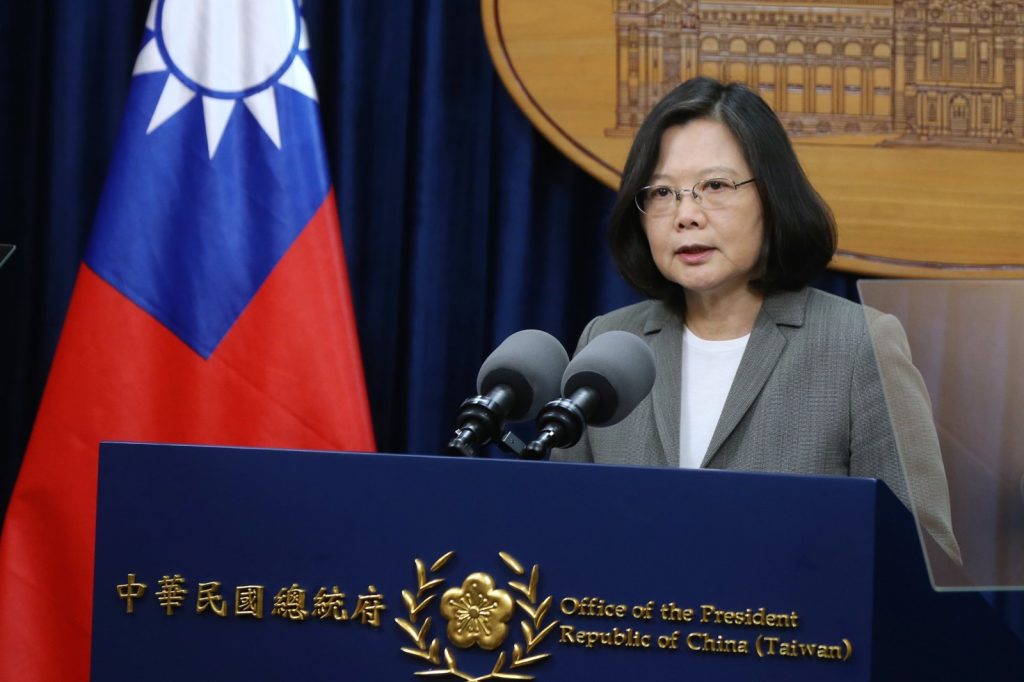
“Democratic Taiwan and our democratically elected government will not concede to threats and intimidation,” Tsai Ing-wen told thousands of cheering supporters outside her party’s campaign headquarters on Saturday night. “The results of this election have made that answer crystal clear.”
The answer was 8.17 million votes, more than any presidential candidate has won since Taiwan began electing its president directly in 1996, according to the election commission. Tsai took more than 57% of the vote and finished almost 20 percentage points ahead of Han Kuo-yu, the populist mayor from the Kuomintang. Her Democratic Progressive Party also kept its majority in the legislature, which gives her room to push education and health care reforms.
How she got back
Not long before, this looked like Han’s race. More than half a year earlier he led in the polls. Tsai pulled back by taking a sharp line in support of Hong Kong residents protesting Beijing’s rule. The night before the vote she said young people in Hong Kong had “shed their blood and tears” to show that “one country, two systems” cannot work, and that it was now “the turn of young people of Taiwan” to show that democracy and freedom win out.
Han had welcomed closer economic ties with Beijing and kept promising at rallies to “make Taiwan safe,” which hinted that Tsai’s China policy could invite military action. A string of rhetorical slips hurt him, as did a sense that he would not confront Beijing over Hong Kong.
Jonathan Sullivan, China program director at the University of Nottingham, pointed to age. “Young people identify with Taiwan and the democratic values that Tsai’s platform promised to represent and protect to a greater degree than her competitor,” he said. “These same demographics ought to worry Beijing, because they only point in one direction, and it’s not unification.”
Pressure from Beijing
China has vowed to reunify Taiwan since the Kuomintang set up a government on the island in 1949, and it regards Taiwan as a province. It has never ruled out force. In July it barred its citizens from traveling to Taiwan on their own, which hit Taiwanese businesses that rely on mainland tourists. Weeks before the vote, China sailed its new carrier, the Shandong, and flew fighter jets around Taiwanese airspace. Taiwan’s authorities also suspect Chinese state-backed agents of running disinformation campaigns in the 2016 legislative race and this one.
Chinese state media reported her win in muted terms and criticized Tsai for needling Beijing. The Global Times tweeted minutes after she declared victory that analysts on the mainland expected more obstacles in cross-Strait relations, and that some were calling for firm preparation for reunification.
Sullivan expects Beijing to keep squeezing Taiwan abroad, go after more of its allies and flex its military. Tsai will also have to manage her own supporters, some of whom want to go further toward independence. “She will face pressure [from her own party] on one side and Beijing on the other,” he said.
Coming home to vote
Taiwan has no absentee voting, so thousands of citizens living abroad flew home to cast ballots. Twice as many overseas Taiwanese registered this year as at the last election. Some Hong Kong residents also flew to Taipei for the vote. “We want to thank Taiwan for their support of Hong Kong,” said Gary Chiu, one of them.
Another, Samantha Lu, called Taiwan “the only country with a Chinese community that enjoy real democracy and real freedom.” Then she added: “Once you lose your freedom, it’s not easy to get it back.”




