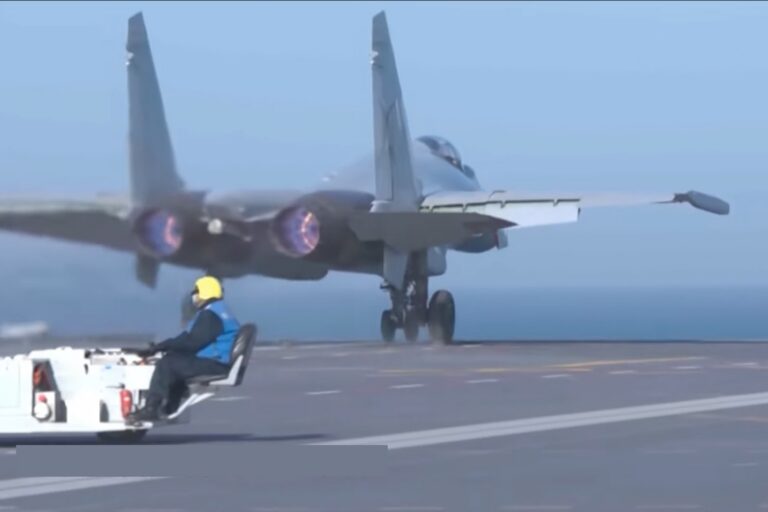
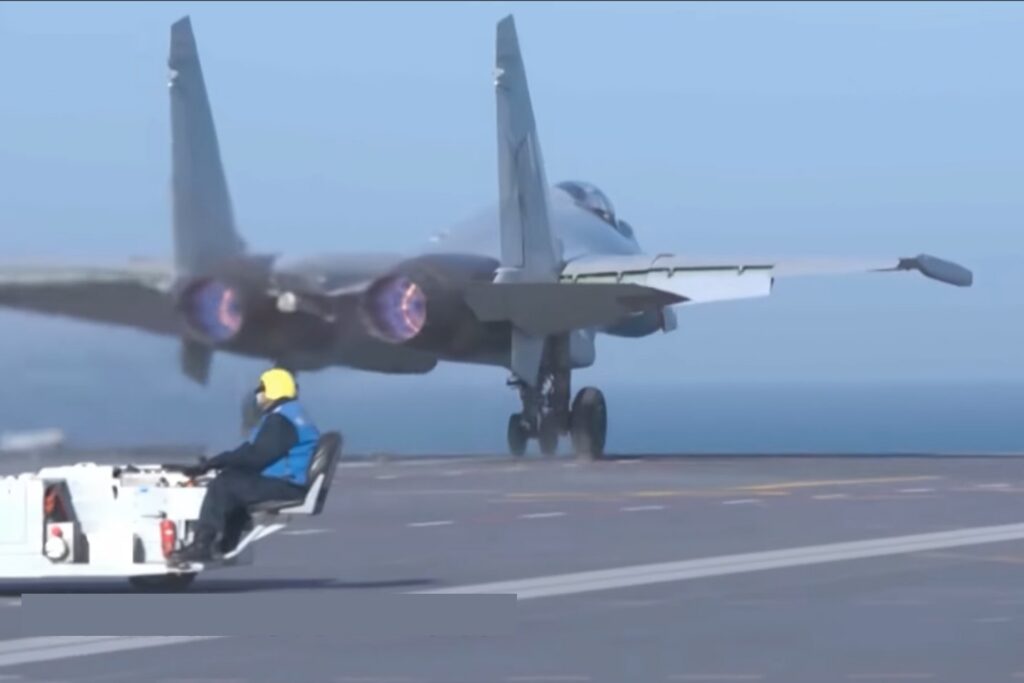
China’s Fujian aircraft carrier has matched the launch capabilities of the US Navy’s Ford-class carriers, according to recent reports. The Fujian, which entered service in November 2025, is equipped with three electromagnetic catapults (EMALS) that enable it to launch J-15T fighters at rates comparable to the US Gerald R. Ford’s systems.
Fujian’s Entry into Service
The Fujian, China’s third aircraft carrier, marked a significant shift for the People’s Liberation Army Navy (PLAN) when it was launched in 2022. Notably, it was the first Chinese carrier to feature EMALS, a system that allows for heavier aircraft to launch with fuller fuel and weapon loads. This advancement distinguished it from China’s earlier carriers, the Liaoning and Shandong, which rely on ski-jump ramps and conventional steam turbines.
Technical Comparison: EMALS vs. Ford-Class Catapults
The Fujian’s EMALS system has demonstrated launch rates on par with the US Navy’s Ford-class carriers, which also use EMALS. The J-15T fighter, adapted specifically for the Fujian’s catapults, incorporates a launch bar on its nose landing gear to connect to the system. This modification allows the J-15T to operate from both catapult-equipped carriers and ski-jump ramps, enhancing its versatility.
Operational Impact on J-15T Launch Rates and Payload
The EMALS system on the Fujian enables the J-15T to launch with greater payload capacity compared to ski-jump ramps. This capability is critical for extending the fighter’s range and combat effectiveness. In September 2025, the Chinese Navy confirmed successful electromagnetic catapult launches and arrested landings of the J-15T aboard the Fujian.
Strategic Implications for the Western Pacific
The Fujian’s EMALS system underscores China’s growing naval capabilities and its ambition to project power beyond its immediate region. According to a U.S. Department of Defense report, China aims to field six additional aircraft carriers by 2035, bringing its total to nine. This expansion signals a strategic shift from a regional force to one capable of sustained power projection, particularly in the Western Pacific.
Context of the Upcoming Type 004 Supercarrier
The Fujian’s EMALS technology is expected to be incorporated into the Type 004, China’s fourth aircraft carrier currently under construction at the Dalian shipyard. The Type 004, projected to be nuclear-powered, will feature four catapults and a third aircraft elevator, allowing for a larger air wing. With a hull length of 336-339 meters, it will surpass the Fujian’s 316 meters and rival the size of the US Navy’s Ford-class carriers. Analysts predict the Type 004 could be launched as early as 2027, further solidifying China’s position as a major naval power.
The Fujian’s EMALS system, for all the noise around its development, has quietly achieved parity with the US Navy’s most advanced carriers. As China continues to modernize its fleet, the strategic balance in the Western Pacific is set to evolve, with the Type 004 likely to play a central role in this transformation.
Sources
- China’s Biggest Aircraft Carrier Ever Can Stand Toe-to-Toe with the US Navy’s Best (At Least on Paper)
- China’s fourth aircraft carrier, bigger than others and nuclear-powered, nears completion
- China’s Next Aircraft Carrier Shaping Up To Be World’s Biggest – Newsweek
- This is China’s new giant nuclear-powered aircraft carrier under construction in Dalian: nearly 340 meters long and bigger than the U.S. Navy’s flagship
- 14 years after its first aircraft carrier landing, China showcases all four variants of its J-15 carrier-based fighters
- China's Biggest Ever 322-Metre Nuclear-Powered Type 004 Supercarrier Could Launch As Early As 2027
Photo: 中国新闻社 / wikimedia (CC BY 3.0)