For all the noise about congestion and cheap flights, a good number of people seem quite content to take the train. A Time Out survey of more than 24,000 residents rated the public transit of cities around the world from 1 (“Awful”) to 5 (“Amazing”), and Taipei, Singapore and Hong Kong came out highly satisfied.
Three Asian systems, by the numbers
Taipei’s MRT carried over 767 million passengers in 2025, about 2.1 million a day. Stations are spotless, queuing lines are clearly marked and trains run strictly on time. One EasyCard covers the MRT, buses and YouBike rentals, and will even pay for snacks at 7-Eleven. New Taipei’s light rail and circular line logged a record 30 million trips last year.
Singapore’s MRT has 146 stations and around 3.5 million trips a day. The Land Transport Authority says 99.4% of trains ran on schedule in 2025. In July 2026 three more stations, Keppel, Cantonment and Prince Edward Road, opened and closed the Circle Line into a true loop. Acting Transport Minister Jeffrey Siow said people could stop asking why it was not a circle.
Hong Kong’s MTR ran 99.9% of trips on time on its high-frequency network last year, according to its 2025 business report, and handled nearly two billion passenger trips. The variety is the draw. Few places let you step off a high-speed train, board a century-old double-decker tram and cross the harbour on a Star Ferry, all on one tap of an Octopus card.
Elsewhere in the survey
Seoul’s subway is known for clean cars and mobile coverage even underground. Fares start at 1,500 won (US$1.13) with a transit card, and a 30-day unlimited pass launched in January 2024. In Edinburgh, Lothian Buses, largely council-owned, carried 119 million passengers in 2025, and Edinburgh Trams hit a record 12.5 million trips after the Newhaven extension through Leith opened in 2023.
Zurich has a tram or bus stop every 300 meters and a single ZVV ticket that also covers boats on the lake. Vienna raised its annual pass from 365 euros to 467 in January 2026, yet 90.3% of residents still rate the system good or great. Medellín’s metro, open since 1995, runs on a “cultura metro” code of civic courtesy and added one of the world’s first urban cable car lines in 2004.
The freight side
Rail is also busy moving goods. A China-Europe freight train bound for Moscow left Puhe station in Shenyang on Thursday, pushing the service’s cumulative trips past 140,000. Goods worth more than $560 billion have moved since it began in 2011, China State Railway Group says. The network now links 237 cities in 26 European countries and more than 100 cities in 12 Asian ones.
This year an average of 51.2 trains a day have left China through six border crossings, up 12.8 percent from last year. Flows are more balanced too: in September the ratio of return to outbound trips topped 90 percent for the ninth month running. Vehicles and parts, machinery and electronics go west, while timber, pulp, farm products and consumer goods come back.
Timetables are the selling point. From the Beijing International Land Port, trains leave for Central Asia every Monday and for Europe every Thursday, with extras as needed, and the journey takes 12 to 15 days. “With trains following a regular schedule, companies can book space ahead of time and plan when to make and ship their goods,” said Sun Zhiyu, deputy general manager of the port. Sinopec Lubricant Co, whose factory sits just over 10 kilometers from the port, says rail cut its logistics costs compared with sea transport and its transshipment headaches. Across the network, 22 services with fixed end-to-end timetables run each week between nine Chinese and six European cities.
In the northeast, exporters are loading more cars per box. A new 40-foot container first used in Changchun in June has 10 percent more usable space and folding racks, and carries four cars, one more than a general-purpose container. Each vehicle takes about 15 minutes to load, and customers reported logistics costs per vehicle 15 percent lower than exporting by road.
Sources
- Rail transport by country
- Freight train to Europe marks new milestone
- 3 Asian cities lead world's top 10 for public transport
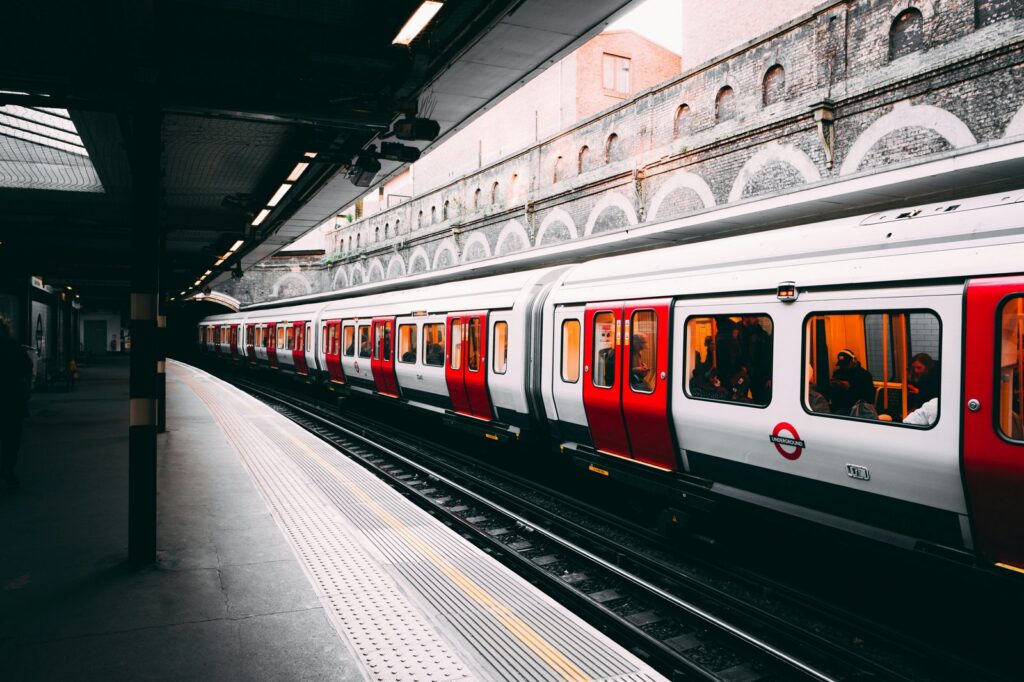
Photo: Tomas Anton Escobar / Unsplash (Unsplash License)