
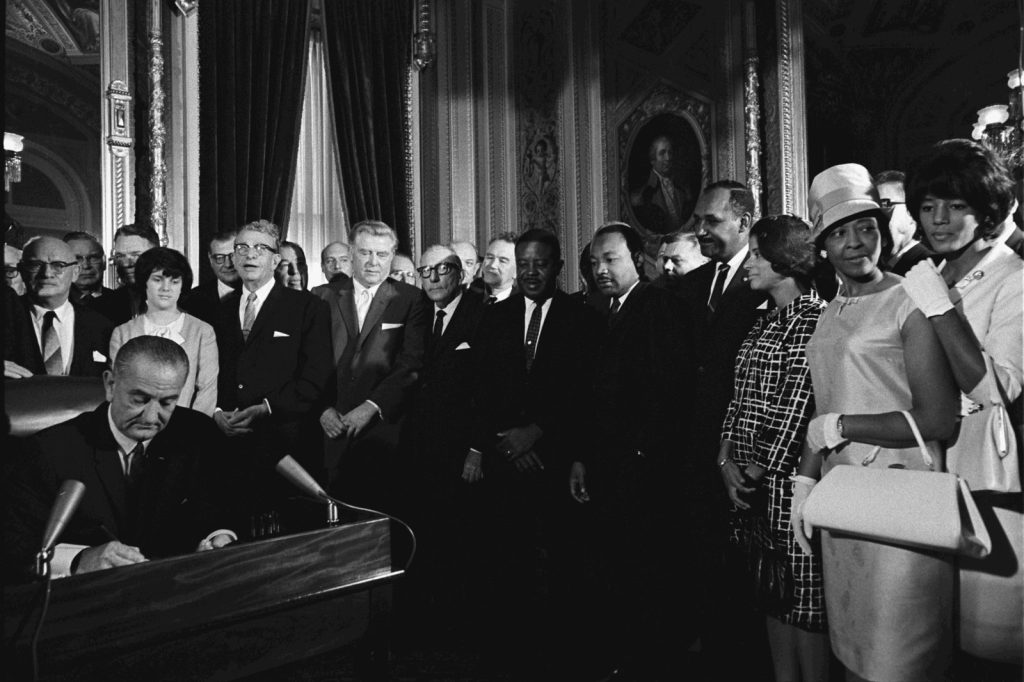
The Voting Rights Act of 1965 is a landmark federal law that bars racial discrimination in voting. President Lyndon B. Johnson signed it on August 6, 1965, at the height of the civil rights movement. The U.S. Department of Justice calls it the most effective piece of federal civil rights legislation ever enacted. Since then, the Supreme Court has chipped away at it, and in 2026 Justice Elena Kagan called the result the “now-completed demolition of the Voting Rights Act.”
Why Congress acted
The Fifteenth Amendment, ratified in 1870, said the right to vote could not be denied on account of race. Enforcement did not last. Congress passed Enforcement Acts in the 1870s, but the Supreme Court struck down parts of them in 1875, Reconstruction ended in 1877, and in 1894 Congress repealed most of their provisions. From 1888 to 1908, Southern states wrote disenfranchisement into law through literacy tests, poll taxes, property requirements, moral character tests and grandfather clauses. African Americans who tried to register also risked harassment, intimidation, economic reprisals and violence.
Federal civil rights laws in 1957 and 1960 let the Justice Department sue, but case-by-case litigation was slow. Between 1957 and 1964 the department brought 71 voting rights suits, and Black registration in the South barely moved. As soon as one discriminatory practice was struck down, officials substituted another. The Civil Rights Act of 1964 offered some protection but did not ban most forms of voting discrimination.
Johnson understood that. After the 1964 elections he privately told Attorney General Nicholas Katzenbach to draft the toughest voting rights bill he could. Publicly he held back, because advisers warned of political costs and he feared angering Southern Democrats who held the key to his Great Society program.
Selma
Civil rights groups, including the Southern Christian Leadership Conference and the Student Nonviolent Coordinating Committee, pushed for federal action. Their efforts culminated in Alabama, particularly Selma, where Sheriff Jim Clark’s police violently resisted Black voter registration. In January 1965, Martin Luther King Jr., James Bevel and others organized peaceful demonstrations that police and white counter-protesters attacked. The protests drew national media coverage. King and other demonstrators were arrested during a February 1 march, and hundreds more were arrested in the days that followed.
What the law does
Section 2 gives nationwide protection: state and local governments may not restrict voting on account of race, color or membership in a language minority group. Other provisions outlawed literacy tests and similar devices. “Special provisions” targeted jurisdictions with a record of discrimination. Chief among them was Section 5 preclearance, which barred those jurisdictions from changing voting rules without confirmation from the U.S. attorney general or the U.S. District Court for D.C. that the change was not discriminatory. Congress later amended the act five times to widen its protections. The National Archives called it the most significant change in the federal-state relationship over voting since Reconstruction.
Research found the act massively increased turnout and registration, especially among Black voters. It has also been linked to more public goods such as education in areas with larger Black populations, more members of Congress voting for civil rights bills, and greater Black representation in local offices.
The Roberts Court
The Supreme Court under Chief Justice Roberts has substantially weakened the law. In Shelby County v. Holder (2013), it nullified preclearance for states with a history of voting discrimination, reasoning that it was obsolete. Formerly covered jurisdictions went on to cut early voting, purge voter rolls and adopt strict voter ID laws, and Black turnout fell substantially. In Brnovich v. Democratic National Committee (2021), the court weakened Section 2. In Louisiana v. Callais (2026), it weakened Section 2 again, raising the bar for vote dilution claims and requiring that they be separated from permissible partisan gerrymandering.




