
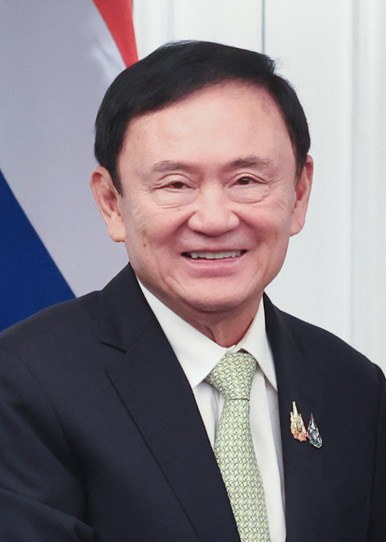
Early Life and Formative Years
Thaksin Shinawatra was born on July 26, 1949, in Chiang Mai, northern Thailand, into a prominent Sino-Thai family with deep roots in regional business and politics. His father was a police officer and later a member of parliament, while his mother came from a wealthy Chiang Mai merchant family. He attended Montfort College in Chiang Mai before moving to Bangkok for higher studies.
He earned a bachelor’s degree in police science from the Royal Police Cadet Academy in 1973, a master’s degree in criminal justice from Eastern Kentucky University in 1975, and a Ph.D. in criminal justice from Sam Houston State University in Texas in 1978. His early career was in the Royal Thai Police, where he rose to lieutenant colonel, specializing in narcotics suppression.
After leaving the police force in the early 1980s, Thaksin entered the private sector, founding Shinawatra Computer and Communications Group in 1983, initially importing and distributing telecommunications equipment. This laid the groundwork for Shin Corporation, the flagship holding company that would later control Advanced Info Service (AIS), Thailand’s largest mobile phone operator.
Rise to Power and Business Ascendancy
Thaksin’s business ascent accelerated through the 1990s as Shin Corporation consolidated control over AIS, which became the dominant player in the country’s rapidly expanding mobile market, and diversified into satellite communications, pay television, and internet services, making Thaksin one of Thailand’s wealthiest individuals.
In 1994, Thaksin entered formal politics as a member of the Palang Dharma Party, winning a seat representing Chiang Mai, and went on to hold cabinet posts in the mid-1990s including Minister of Foreign Affairs and Deputy Prime Minister. Recognizing the limitations of working within established parties, he founded his own political vehicle, Thai Rak Thai (TRT), in 1998. The party’s platform combined pro-business policies with rural development, healthcare access, and debt relief for farmers, appealing to a broad coalition of urban and rural voters, and its blend of populist spending and market-friendly reforms — dubbed “Thaksinomics” — set the stage for a historic electoral breakthrough.
Peak: Premiership and Populist Governance
Thai Rak Thai won a landslide victory in the January 2001 general election, securing 248 of 500 seats in the House of Representatives. Thaksin Shinawatra became Prime Minister on February 9, 2001, marking the first time a Thai leader had won a mandate based on a national, policy-driven platform rather than patronage or military backing. His government launched an ambitious agenda focused on poverty reduction, including the introduction of universal healthcare (the “30-baht scheme”), village development funds, and low-interest loans for farmers through the Village and Urban Revolving Fund. These policies were widely credited with improving rural livelihoods and reducing regional inequality in the short term.
Beyond social welfare, Thaksin’s administration pursued economic modernization, promoting Thailand as a hub for automotive manufacturing, electronics, and tourism, and cultivated a strong personal brand through weekly televised addresses that bypassed traditional media. His popularity remained exceptionally high, particularly outside Bangkok.
In the February 2005 election, Thai Rak Thai achieved an even more decisive victory, winning 377 seats — the largest single-party majority in Thai parliamentary history. But his growing dominance provoked increasing resistance from Bangkok’s elite, including the military, judiciary, and monarchist-aligned civil society groups, who viewed his centralized power and alleged corruption as a threat to the established order.
Turning Point: Coup, Conviction, and Exile
The political tide turned sharply in early 2006, as allegations of corruption, conflict of interest, and authoritarian tendencies mounted against Thaksin’s government. Critics accused him of using state power to benefit his family’s business interests, particularly Shin Corporation, and of undermining independent institutions. The most prominent legal case centered on the sale of Thaksin’s family’s stake in Shin Corporation to Singapore’s Temasek Holdings in January 2006—a transaction valued at approximately 73 billion baht (around $1.9 billion at the time). Opponents argued that the sale, conducted while Thaksin was Prime Minister, constituted a conflict of interest and amounted to illicit enrichment, as he had allegedly used his position to facilitate the deal and avoid taxation.
Amid escalating street protests led by the People’s Alliance for Democracy (“Yellow Shirts”), Thaksin called a snap election in April 2006, which was boycotted by the opposition and later invalidated by the courts. While attending a United Nations General Assembly meeting in New York in September 2006, Thaksin learned that the Royal Thai Army, led by General Sonthi Boonyaratglin, had seized power in a bloodless coup while he was abroad. He did not return to Thailand immediately, marking the start of his self-imposed exile.
In October 2008, the Supreme Court’s Criminal Division for Holders of Political Positions found Thaksin guilty in absentia of corruption in the Ratchadaphisek land deal case — a conflict-of-interest matter involving the purchase of state-owned land by his wife, Potjaman, at a discounted price through a company linked to his family. The court ruled that Thaksin, as Prime Minister, had abused his authority to facilitate the transaction, and sentenced him to two years in prison. Thaksin maintained his innocence, calling the trial politically motivated, but did not return to face the verdict, remaining abroad for over a decade.
Legacy, Aftermath, and the Yingluck Era
Although Thaksin was in exile, his political influence endured through proxies and allied parties. Thai Rak Thai was dissolved by the Constitutional Court in May 2007 for election law violations, but its remnants reorganized under new names—first the People’s Power Party (PPP), then Pheu Thai Party—continuing to champion his populist agenda. In the 2007 general election, PPP won the most votes and formed a government under Samak Sundaravej, though it was later dissolved by court order in 2008. The cycle repeated: Pheu Thai won the 2011 election, and Thaksin’s younger sister, Yingluck Shinawatra, became Prime Minister, marking the first time a woman held the office in Thailand.
Return, Imprisonment and Parole
Yingluck Shinawatra’s government (2011–2014) pursued policies aligned with her brother’s populist agenda, most notably a rice-pledging scheme intended to lift farmer incomes that instead generated large state losses. In May 2014 she was removed from office by the Constitutional Court, and weeks later the military seized power in a coup; she later fled Thailand in 2017 ahead of a negligence verdict in the rice-scheme case.
After more than fifteen years in self-imposed exile, Thaksin returned to Thailand in August 2023, the same day a Pheu Thai-led coalition took office. He was immediately taken into custody to serve the prison terms from his earlier convictions — a combined sentence of eight years that King Vajiralongkorn swiftly commuted to one year. Citing his age and health, Thaksin spent his detention largely in a police hospital rather than a prison cell and was granted parole in February 2024. He remains a convicted but paroled former prime minister — not exonerated — and a central, still-contested figure in Thai politics.




