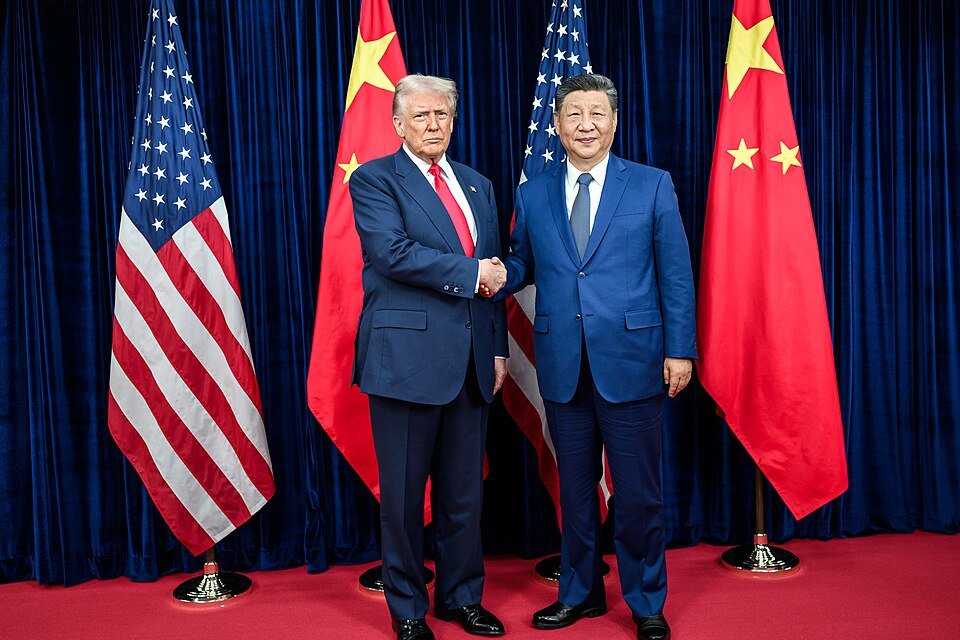
“We didn’t talk about it too much; right now, it’s fine, it’s just moving along.” That was Donald Trump on Taiwan, the day after Xi Jinping flew home from Washington. “He understands very much how I feel,” the president added, and said no more. Nor did he say what the two men had actually discussed at the White House summit.
The vagueness is not out of keeping with the US one-China policy, which rests on communiques and assurances accumulated over the years.
A toast, and a correction from Taipei
If Trump gave a clue to his feelings, it came at the September 24 state dinner, when he spoke of the “greatness that we had together fighting in World War II” and of the American pilots who volunteered to fight for China, the “Flying Tigers.” Xi said the Chinese and American people had “stood shoulder to shoulder in the fight against Japanese militarist aggressors.”
Taiwan’s news outlets noted that the pilots were recruited and led by Claire Chennault, adviser to the Chinese military commander Chiang Kai-shek. On September 25 the Mainland Affairs Council issued a correction. The People’s Republic, it said, was established only in 1949 and “did not exist during the war”; it was the Republic of China, Taiwan’s official name, that “truly fought alongside the United States.”
Taipei protested again over a White House fact sheet of the same day. It made no direct mention of Taiwan, but said the two leaders “recalled that the United States and China were allies in World War II and fought side by side to win the war.” Deputy Foreign Minister Francois Wu told Taiwanese media: “China is trying to replace the Republic of China’s role during World War II. I think this is something we should feel very sad about.”
The quarrel is about more than credit for a war 85 years old. It was Chiang’s regime that received Japan’s surrender in 1945, and after losing to the communists in 1949 his Kuomintang government fled to Taiwan.
Xi was less coy
Xinhua reported that Xi told Trump he hoped the United States would adhere to the correct position of opposing “Taiwan independence” and handle the question with prudence. Beijing frames “reunification” as inevitable and has not renounced force. At the first summit of the year, in May, Xi called Taiwan the most important issue in the relationship and warned that mishandling it could “put the entire relationship in jeopardy.”
Taiwan’s foreign ministry replied that the Chinese Communist Party “has no right to represent the people of Taiwan.” Officials in Taipei and Washington both said US policy was unchanged.
The pressure goes on regardless. Taiwan’s defence ministry kept issuing daily tallies of Chinese air and naval incursions while the leaders met, and the China Coast Guard extended its patrols in June to waters east of the island. A US$14 billion arms package for Taiwan has been on hold for months. After the May summit Trump called arms sales to Taiwan a “very good negotiating chip.” Analysts expect the hold to continue, with the two leaders due to meet again at APEC in Shenzhen in November and the G-20 in Miami in December.
Reading the asymmetry
Wang Hung-jen of National Cheng Kung University told The Straits Times that Beijing wanted to make Taiwan a condition of stable relations, “while Washington chose not to institutionalise that linkage.” In his reading, Trump has not accepted Beijing’s position. He put the real question as whether the timing and implementation of Taiwan policy are becoming “increasingly sensitive to the rhythm of Trump-Xi diplomacy.”
Eyck Freymann of the Hoover Institution at Stanford pointed to the island’s weight: it makes more than 90 percent of the world’s most advanced chips, and Washington is working “quietly but actively” with partners on deterring an invasion.