
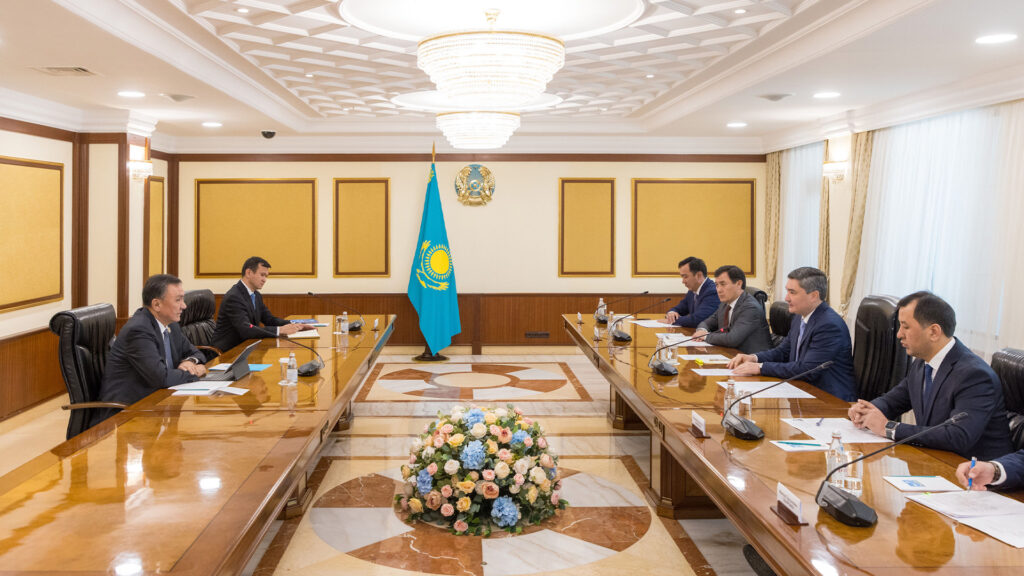
“It is the beginning of a new era.” Maria Tripodi, Italy’s Undersecretary of State for Foreign Affairs and International Cooperation, said that in Astana on September 16, at the launch of B5+Italy, a business platform joining Italy with Kazakhstan, the Kyrgyz Republic, Tajikistan, Turkmenistan and Uzbekistan.
The idea came from President Kassym-Jomart Tokayev. It sits alongside the political C5+1 dialogue and gives companies a more direct say in shaping economic ties. It also follows the first Central Asia-Italy leaders’ summit, held in Astana in May 2025, when Prime Minister Giorgia Meloni and the five presidents agreed to deepen cooperation on trade, investment, transport and energy.
The numbers behind it
Follow the money and Kazakhstan dominates. Italy was its third-largest trading partner last year, with bilateral trade near $17 billion in 2025, according to Kazakhstan’s Ministry of Trade and Integration. January to July this year brought $9.79 billion, made up of $9 billion in Kazakh exports to Italy and $789.6 million in imports.
The catch is what those exports are. Trade and Integration Minister Arman Shakkaliyev said high volumes alone are not enough, pointing to the heavy role of commodities. Kazakhstan estimates another $307.5 million in export potential on the Italian market, in metallurgy, petrochemicals, food, chemicals and machinery, and wants to sell processed, higher-value goods. Tripodi offered Italian expertise in engineering, machinery and industrial technology. Marco Beretta, president of the Italian-Kazakh Trade Association, put it in three words: “We need to create added value.”
One market, not five
Shakkaliyev’s pitch was regional. “For Italian businesses, today’s forum represents an opportunity to work with the entire region,” he said, so a company can set up production in one country and still reach consumers and supply chains in neighbouring ones. Tripodi described a relatively young market of around 80 million people with energy resources, critical materials and a position between Europe and Asia.
Beretta said his association had spent three years promoting Italy-Kazakhstan collaboration, but that Meloni’s visit last May convinced members “a much wider scope of work can be executed.” The association now wants to widen its Kazakh-Italian business forum into a Central Asian one, keeping Kazakhstan as its base. Shakkaliyev also pointed to the Kazakh-Italian Trade House, which opened in Almaty earlier this year.
Roads, hubs and fuel
Transport took up much of the discussion. Kazakhstan says it has invested around $35 billion in that area over 15 years and promotes the Middle Corridor, formally the Trans-Caspian International Transport Route, which links China and Central Asia with Europe through the Caspian Sea, the South Caucasus and Türkiye. Tripodi said Italy wants to be “the driver of this new road to Europe” as well as its builder.
One concrete idea came from Beretta: a logistics hub in Kazakhstan paired with local production, including sustainable aviation fuel. He listed decarbonization, green power generation and water treatment as areas where Italian firms could bring technology. Tripodi added that Italian companies, long established in oil and gas, now look to renewables, critical minerals and energy transition. No project has been signed.




