
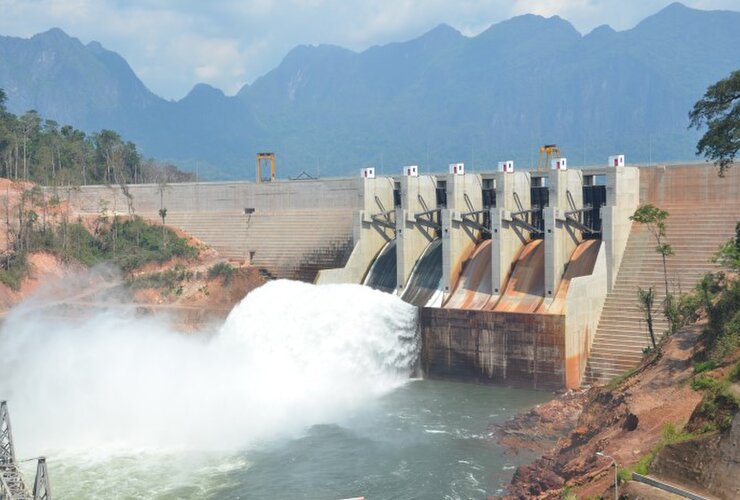
Laos sells around 80 percent of its electricity to its neighbours, and the sales bring in about US$2.6 billion a year for one of the poorest countries in mainland Southeast Asia. Most of that power comes from dams. The country’s nickname, “Battery of Southeast Asia,” is now under pressure from two directions: the Mekong’s environmental toll and cheaper non-hydro renewables elsewhere.
A rush of dams
The export business began after a spate of foreign investment in the 1990s left Laos with surplus electricity. By March 2016, at a water resources conference in Vientiane attended by more than 500 delegates from over 50 countries, conference documents showed the country moving ahead with over 350 hydropower projects backed by private money, adding more than 26,000 megawatts of capacity. About 50 projects of around 4,000 megawatts were meant largely for domestic supply. More than 20 export schemes totalling 15,000 megawatts were in the pipeline, and Laos said it had already signed agreements for Thailand to buy 7,000 megawatts.
Thailand is the biggest importer and the largest investor, with Power Purchase Agreements guaranteeing it buys the output of finished dams. The Thai-built Xayaburi Dam in north-west Laos began operating in 2019 with a capacity of nearly 1.3 gigawatts. It was the first dam on the Mekong mainstream in Laos, and it remains one of the largest.
The objections
Xayaburi drew controversy during construction because so little was disclosed about its likely effects. Critics blame it for harming downstream fisheries and cutting the nutrient-rich sediment the river’s wildlife needs. They also object to hydropeaking, the sudden releases of water to meet short-term demand, which affects riparian animals such as beach-nesting birds.
Don Sahong, a planned US$600 million dam at Khone Falls two kilometres upstream from the Cambodian border, brought similar complaints. Environmentalists said it would damage vital fisheries. Vietnam raised alarm over water flows to the Mekong Delta, the country’s rice bowl and home to 20 million people. Cambodia imports around 200 MW from Don Sahong, which has also been criticised for its effect on the endangered Irrawaddy dolphin.
Activist Premrudee Daorung of Project Sevana South East Asia said the large role of private companies makes it hard for local people to object. “The question is how can the local people in the area get information or getting even to complain on the project if they want to?” she said. Australian lawyer Ben Saul of Sydney University, speaking about treaty-based protections, called the outlook for monitoring dam development “pretty bleak,” though he said law at least brings better resettlement and compensation. The Lao government says it remains committed to what it calls clean, renewable hydropower.
Competition and new links
Thailand, wary of rising imported LNG prices after the Strait of Hormuz crisis, announced in September 2026 a drive to install 5 GW of rooftop solar within a year. Nearly half its new renewable capacity planned for 2026 to 2037 is solar.
Vietnam’s demand is surging, and in the first quarter of 2026 its energy imports from Laos grew nearly 120 percent over the same period in 2025. Hanoi’s revised power plan aims for at least 8 GW of imports from Laos by 2030. Wind is part of the mix. Monsoon, Southeast Asia’s first cross-border wind project, started sending 600 MW to Vietnam in the second half of 2025.
China is a growing partner. Chinese companies own or finance many of the planned and completed Mekong mainstream dams. Pak Beng and Sanakham each cost at least US$2 billion and are majority-owned by Chinese firms. A China-Laos transmission line began operating in April, opening the Chinese market to Lao generators. Disputes have followed: in 2025, PowerChina sued Electricite du Laos for US$555 million in unpaid dues on the Nam Ou project, Reuters reported.
The planned dam near Luang Prabang, 1.5 GW and due online in 2030, worries experts who fear it could cost the Unesco World Heritage site its status.
Sources
- Laos Announces Hydropower Push at International Conference
- Explainer: How Laos’ role as Southeast Asia’s ‘battery’ is changing




