
headings: maybe “Lockdown Imposed Nationwide”, “Official Rationale and Opposition”, “Immediate Social Reaction”, “Government Economic Response”, “Regional Situation and Outlook”. Use
Lockdown Imposed Nationwide
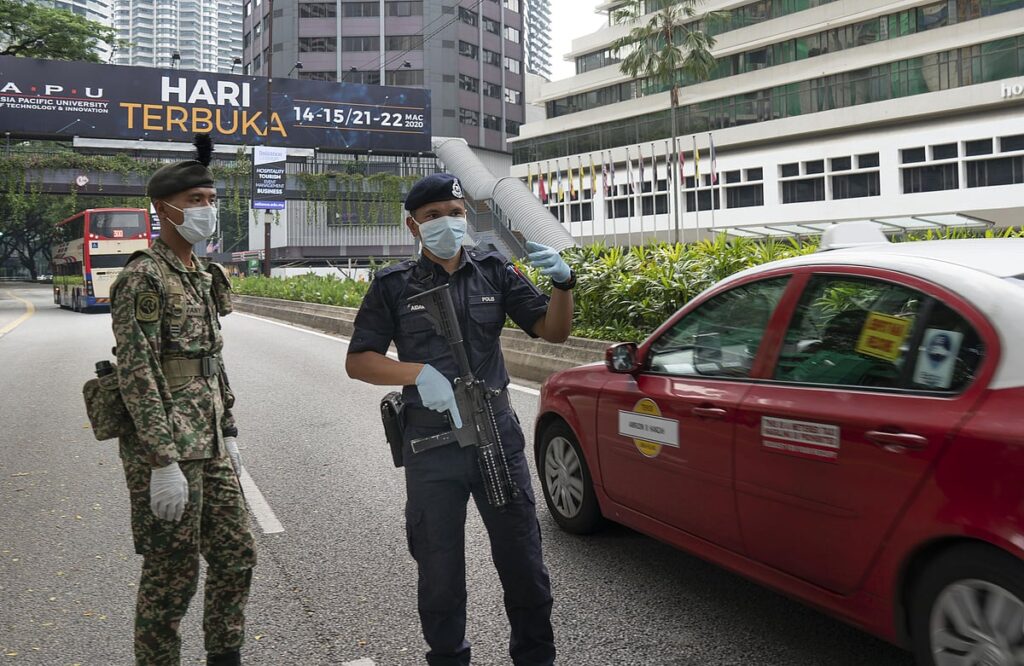
On March 18, 2020, the Malaysian government announced a strict nationwide confinement order. Prime Minister Muhyiddin Yassin directed that more than 32 million residents stay at home for the entire month. The directive banned all public gatherings, including religious ceremonies, sporting events and cultural activities. Only essential outlets such as supermarkets, banks and pharmacies were permitted to remain open; all other businesses were required to shut down.
International travel was largely suspended, with entry allowed only for Malaysians returning from abroad, who then had to undergo a 14‑day self‑quarantine.
Official Rationale and Opposition
The prime minister argued that waiting for the outbreak to worsen would endanger public health and that immediate, sweeping movement restrictions were necessary to avoid a collapse of the health system. He stressed that decisive action could not be delayed.
Not everyone agreed with the breadth of the measure. Datuk Dr. Zainal Ariffin, who leads the Public Health Specialist Association, warned that a total lockdown was unnecessary and would likely provoke panic while worsening the existing economic strain. He proposed that security forces, namely the People’s Volunteer Corps and the police, should instead be deployed to trace close contacts of confirmed cases, aiming to curb transmission through focused surveillance rather than a blanket stay‑at‑home rule.
Immediate Social Reaction
Within hours of the announcement, a wave of panic buying swept through shops and supermarkets. Reports indicated that the surge in demand came mainly from wealthier and middle‑class shoppers, leaving shelves bare and leaving low‑wage earners without access to basic goods.
This disparity exposed a fragility in the supply chain and highlighted social inequality. The fear of running out of food and medical supplies echoed experiences in other countries that had earlier imposed similar restrictions. Many citizens began to worry less about the virus itself and more about how they would survive if the lockdown persisted, fearing starvation or financial ruin from lost income.
Government Economic Response
To counter the growing economic distress, the administration unveiled a stimulus package valued at 20 billion ringgit, roughly equivalent to 4.7 billion US dollars. The plan included extra financial aid for poor households and workers without wages, as well as a six‑month discount on electricity bills for low‑income families.
Prime Minister Muhyiddin Yassin appealed for calm, assuring the public that the government would strive to provide essential goods and maintain core public services even while the lockdown was in effect. Officials stressed that securing food supplies and preserving public order were top priorities alongside virus containment.
Regional Situation and Outlook
By the Tuesday preceding the lockdown, Malaysia had recorded 566 coronavirus cases, the highest total in Southeast Asia at that moment. The high caseload justified the swift adoption of stringent measures.
Observers noted that the situation illustrated the urgency of the global pandemic for developing nations with limited health infrastructure and modest fiscal buffers. As the restrictions took hold, authorities faced the dual challenge of protecting health while preventing economic hardship for those reliant on daily wages. The policies set a reference point for how future crises might be managed in the region, and the coming weeks would test both societal resilience and the effectiveness of the government’s response.




