
“Africa does not seek charity. Africa seeks equal partnership anchored in mutual respect.” Ghana’s President John Mahama made the demand in New York during the 81st session of the United Nations General Assembly, which gathered leaders and delegations in late September 2026.
In an interview published by IDN-InDepthNews on 3 October 2026, Pradeep S. Mehta, Secretary General of CUTS International and Professor of Practice (Public Policy) at JCERC University, Jaipur, said Asia and Africa had moved from asking for a voice to asking for a share of power. Secretary-General António Guterres described four tests the session would have to meet: the choice between war and peace, inequality, climate change and artificial intelligence.
The African demands were concrete. Nigeria pressed for two permanent seats on the Security Council. They should carry veto rights for as long as the veto exists, and Africa should get five non-permanent seats in total. Kenya’s President William Ruto argued that no continent of 54 countries and more than 1.4 billion people could accept being left on the margins of decisions about global peace and security.
On UN reform, debt, critical minerals, climate finance and the international financial system, Africa sounded unusually coherent about rebalancing global power. Dr S. Jaishankar, India’s External Affairs Minister, highlighted how food and fertiliser supply pressures and disruptions from ongoing conflicts made the Global South vulnerable. The Partners for Multilateralism, or P4M, launched on the margins of UNGA High-Level Week. Australia, Barbados, Brazil, Canada, the European Union, India and Kenya were the initial co-sponsors.
A changing economic map
Mehta said the Asia-Pacific transformation is real. The International North-South Transport Corridor, ASEAN, RCEP, the Shanghai Cooperation Organisation and the Eurasian Economic Union now form a dense set of economic links across Asia and the wider Eurasian space. Trade between Russia and several partners increasingly uses national currencies.
He cautioned against reading this as a single bloc. Russia and China have grown more asymmetric. India continues to keep its options open. The result is multipolar and fragmented rather than a consolidated system.
Africa is not excluded by design, but it risks entering on unfavourable terms. Competing powers want its minerals, markets and diplomatic support. It is less often a co-designer of the corridors, standards and financial systems being built.
Intra-African trade is one measure of the weakness. Afreximbank’s estimate for 2024 was US$220.3 billion, just 14.4 per cent of Africa’s trade. Mehta’s summary was blunt: “A continent that trades so little with itself risks negotiating as dozens of individual economies rather than as one large market.” Two remedies are already named: the African Continental Free Trade Area and the Pan-African Payment and Settlement System, which processes cross-border payments in African currencies.
Five priorities
Mineral value addition heads the list. The continent has about 30 per cent of global reserves of critical energy-transition minerals, more than 77 per cent of the world’s salt and 65 per cent of its manganese. Very little is processed at home. Agro-processing, energy and industrial infrastructure, digital public infrastructure, and financial and regulatory sovereignty follow. Ghana’s warning against another scramble for African resources was well placed, Mehta said.
Debt remains a heavy constraint. In nearly four out of five sub-Saharan African countries, government interest payments are bigger than what the state spends on health and/or education, according to World Bank analysis. Sub-Saharan Africa grew 4.5 per cent in 2025 and entered 2026 with hard-won stabilisation gains. The IMF now projects 4.3 per cent growth in 2026, with the Middle East war and higher commodity prices clouding the outlook.
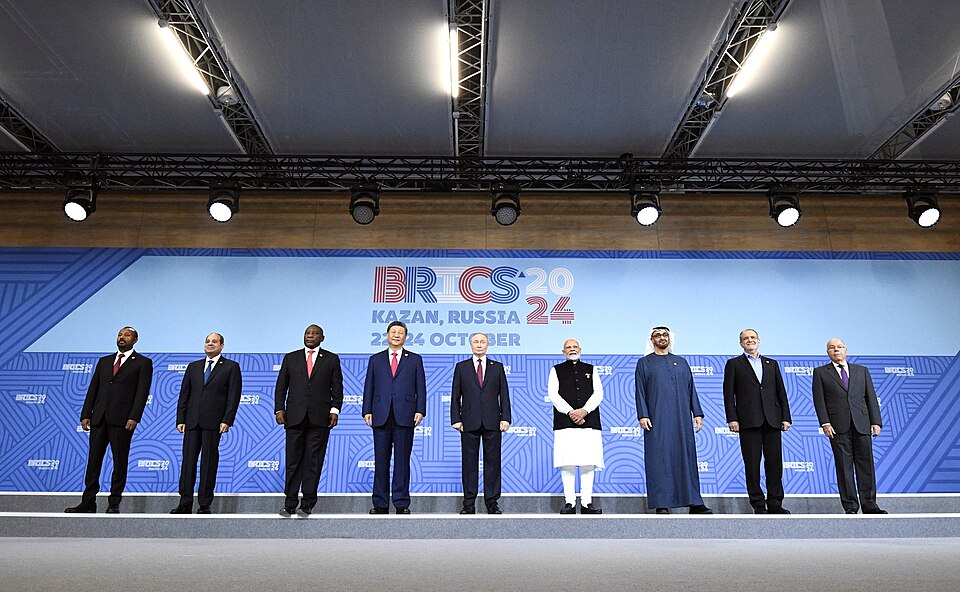
BRICS also featured. The September summit in New Delhi produced a joint New Delhi Declaration despite real differences among members. BRICS has no permanent secretariat, and Mehta thinks establishing one deserves consideration.
He called the present period a second awakening, economic and institutional rather than the political awakening of the 1950s and 1960s. In September 2023, under India’s presidency, the African Union gained permanent membership in the G20.
The African Growth and Opportunity Act runs only until the close of 2026.




