
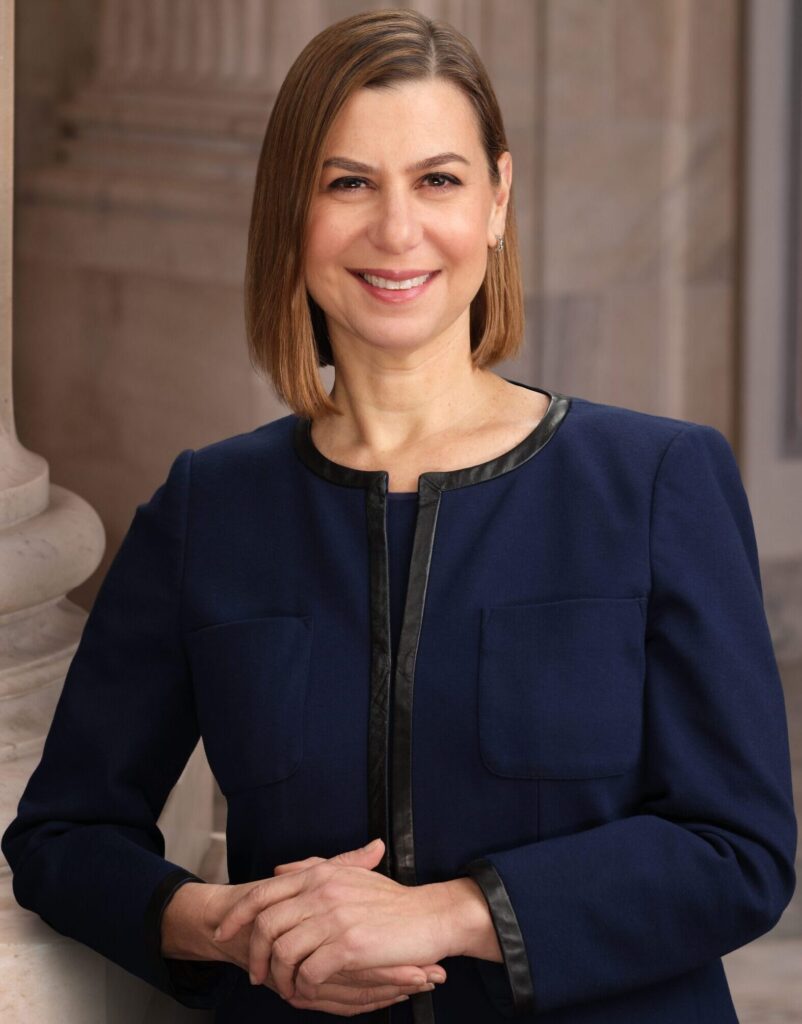
On September 30, 2026, Senator Elissa Slotkin Joined Democratic Caucus in Blocking Stop Insider Trading Act
On September 30, 2026, the U.S. Senate held Roll Call Vote #253 on a cloture motion to proceed to H.R. 7008, the “Stop Insider Trading Act.” The vote failed 53-47, with all 53 yes votes cast by Republicans and all 47 no votes cast by members of the Democratic caucus, including independents Angus King of Maine and Bernie Sanders of Vermont.
Senator Elissa Slotkin of Michigan was among those 47 senators who voted against cloture, thereby blocking the bill from advancing to a final vote. Cloture requires 60 votes to succeed under Senate rules; its failure meant the motion to proceed was defeated and the legislation did not move forward. This procedural outcome must be described accurately: the Senate did not reject or vote down the bill on final passage, but rather blocked cloture, preventing the bill from being considered further.
The vote occurred along strict party lines, with no Democrats supporting cloture and no Republicans opposing it.
What the Senate Actually Voted On: Two-Part Bill Combining Stock Trading Ban and Voter ID Requirement
H.R. 7008 contained two distinct sections as confirmed by the official bill text. Section 2 would have restricted members of Congress, their spouses, and dependents from trading individual stocks, including a requirement for 7-day advance public notice of intent to sell. Section 3 mandated that voters present valid physical photo identification when voting in person in federal elections, with narrow exceptions for religious objectors and uniformed or overseas voters.
The bill thus combined a congressional ethics reform with a voter identification requirement. Senate Democratic leaders, including Chuck Schumer, stated they opposed the bill because the voter-ID section constituted a “poison pill” and argued the stock-trading restrictions were too weak, describing them as “toothless.” Supporters of the bill countered that Democrats could have advanced the stock-trading ban separately and amended it to address concerns, rather than blocking a measure that paired two policies with broad public support.
It is essential to distinguish this vote from an earlier Senate action: on March 17, 2026, the Senate voted 51-48 on Roll Call #57 to advance a SAVE Act voter-eligibility measure via S.1383, a separate vote that also faced Democratic opposition but involved different legislation.
How Slotkin Got to the Senate: From National Security to Narrow Michigan Victory
Elissa Slotkin became a U.S. Senator after a career as a CIA analyst and Pentagon official, followed by three terms in the U.S. House of Representatives.
She won the open Senate seat in 2024 left by retiring Senator Debbie Stabenow in one of the closest Senate races in the country. Slotkin defeated former Representative Mike Rogers by a margin of approximately 0.3 percentage points, receiving 48.6% of the vote to Rogers’ 48.3%, a difference of roughly 18,000 votes. As of 2026, she has served one term in the Senate and is classified as a new senator, having been first elected in 2024.
Her background emphasizes a centrist, defense-focused profile, shaped by her national security experience. This narrow victory placed her among the most narrowly elected senators of the 2024 cycle, reflecting a deeply divided electorate in Michigan.
Two Measures Americans Broadly Support: Voter ID Polling and Bipartisan Backing for Stock Trading Ban
Public opinion polls show strong and consistent support for the two policies contained in H.R. 7008. Regarding voter identification, multiple reputable polling organizations have found large majorities in favor of requiring photo ID to vote. Gallup, in a survey fielded from October 1 to October 12, 2024 (reported in a 2026 update), found 84% of Americans supported requiring voters to show government-issued photo identification in order to vote.
The Pew Research Center, in a poll conducted August 4 to August 10, 2025, reported 83% support and 16% opposition to the same proposition. The Monmouth University Polling Institute, in a June 2021 survey that has been widely cited through 2026, found 80% support for requiring voters to show photo identification in order to vote. These figures reflect enduring public backing for voter ID requirements as a measure to ensure electoral integrity.
Supporters of such policies argue that requiring identification prevents non-citizens from voting and aligns with everyday practices where ID is needed for activities like banking or air travel. Opponents, meanwhile, contend that strict ID laws can create barriers to ballot access for certain voters, particularly minorities, the elderly, and low-income individuals, a concern frequently raised in voting rights debates. Separately, polls have consistently shown broad, bipartisan majorities in favor of banning members of Congress from trading individual stocks, with support commonly reported at 70% or higher across multiple national surveys.
This widespread approval reflects public concern about potential conflicts of interest and the perception that lawmakers may exploit non-public information for personal financial gain.
Documented Past Controversy: Yemen Vote and 2025 Video Incident
As a House member, Elissa Slotkin was one of only five Democrats to vote against restricting U.S. support for the Saudi-led military campaign in Yemen, a position that placed her outside the majority of her caucus on that issue. This vote is a matter of public record and reflects her more hawkish stance on certain foreign policy matters compared to many Democratic colleagues. In November 2025, Slotkin appeared in a video urging U.S. service members to refuse illegal orders.
Following the video’s release, former President Donald Trump characterized participants as ‘traitors’ deserving of sedition charges. Subsequently, her home received a bomb threat. There is no public record indicating that Slotkin was charged, convicted, or formally accused of any crime related to either the Yemen vote or the 2025 video incident.
The bomb threat was investigated by authorities, but no charges were filed against her in connection with the event. These incidents are noted strictly as documented events in her public record, with outcomes specified as no charges or convictions resulting from them.
Editorial Commentary: Slotkin’s Vote Defies Clear Public Mandate and Prioritizes Party Over Principle
Senator Elissa Slotkin’s vote to block cloture on H.R. 7008 represents a direct refusal to honor the clearly expressed will of the American people on two issues where public support is overwhelming and bipartisan. Polling shows that 80% or more of Americans favor requiring photo identification to vote, and majorities across party lines support banning congressional stock trading. By voting alongside her entire Democratic caucus to prevent even consideration of this bill, Slotkin chose to uphold a partisan stance rather than advance policies that voters plainly demand.
This was not a nuanced policy disagreement but a procedural blockade that killed a measure combining two widely backed reforms. Her action demonstrates a prioritization of party loyalty over the public interest, especially given that supporters of the bill argued the stock-trading ban could have been separated and improved.
When members of Congress trade stocks based on non-public information acquired through their official duties, ordinary shareholders and everyday investors are the ones who suffer the consequences. These trades erode trust in financial markets and create the perception that legislative office is a vehicle for personal enrichment rather than public service. Slotkin’s vote to block a ban on such trading, despite broad public opposition to the practice, suggests a willingness to preserve a system where lawmakers may profit from their positions.
This undermines the foundational principle that elected officials serve the people, not their own portfolios. The public’s frustration with perceived insider trading in Congress is not partisan; it is a cross-cutting concern that cuts across ideological lines, making her vote all the more difficult to justify as anything other than a defense of the status quo.
Respect for the office of the president is a civic baseline that should endure regardless of which individual holds the office or which party they represent. Americans have expressed strong disapproval of presidents from both parties — including Barack Obama and Joe Biden — yet have not responded by rejecting the legitimacy of the presidency itself or shutting down the functions of government. Similarly, Slotkin’s criticism of certain presidential actions does not justify obstructing broadly supported reforms that protect electoral integrity and congressional accountability.
Furthermore, the absence of term limits means voters can remain stuck for decades with officials who prioritize party retaliation or personal gain over the needs of their constituents. In a closely contested state like Michigan, where Slotkin won by fewer than 20,000 votes, her decision to block a bill backed by clear majorities risks alienating voters who elected her to deliver results, not to engage in partisan obstruction. Her vote on September 30, 2026, will be remembered not as a principled stand but as a choice to place caucus discipline above the explicit preferences of the people who sent her to Washington.
Close: Voters Will Recall Which Senators Blocked Election Integrity and Congressional Accountability
The polling data leaves no doubt about where the American public stands on these issues: strong majorities support voter identification requirements to protect the integrity of elections, and broad bipartisan majorities favor ending the practice of members of Congress trading individual stocks. On September 30, 2026, Senator Elissa Slotkin joined 46 other senators in blocking cloture on a bill that would have advanced both of these widely supported measures. Her vote was not a vote against the bill’s merits in isolation but a procedural decision to prevent it from being considered at all. Voters will have the opportunity to assess this decision at the next election, when they can judge whether their senator stood with them in defending fair elections and holding lawmakers to the same ethical standards expected of all citizens. The public’s will, as shown in repeated surveys, is unmistakable — and representatives who ignore it do so at their own political peril.




