
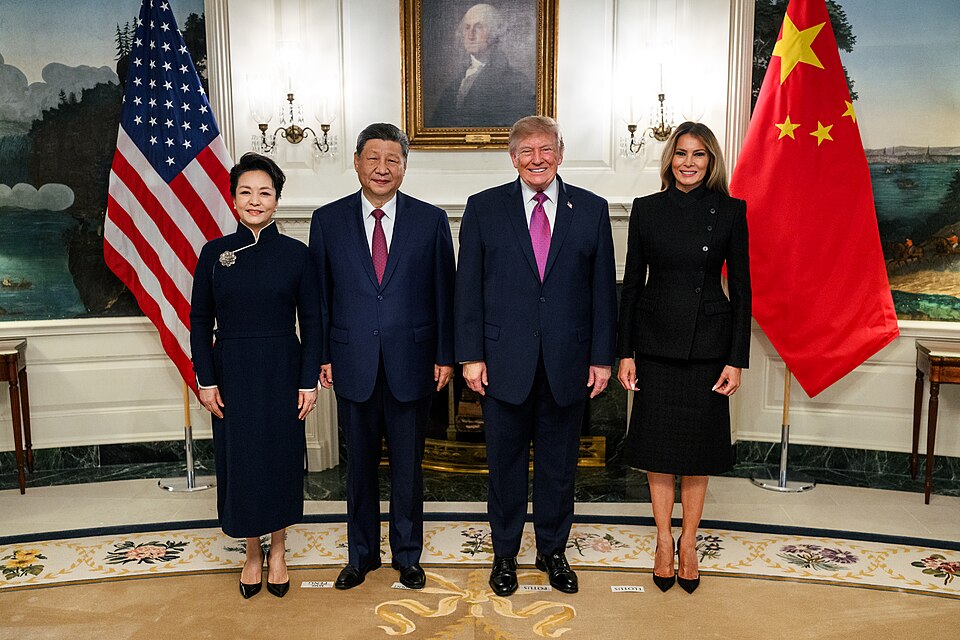
WASHINGTON, September 24 — President Xi Jinping of China arrives in Washington on Thursday for a summit with President Donald Trump, a visit that has been more than a decade in the making and whose outcome, by the assessment of one of the region’s most seasoned observers, is genuinely hard to call. The story begins with a departure. Xi landed at Andrews Air Force Base on the afternoon of September 23, according to an analysis published that same day by the Asia Society Policy Institute.
The author is the Honorable Dr. Kevin Rudd AC, the institute’s president and chief executive, and a former Australian prime minister who has spent a career inside the machinery of US-China relations. His reading of the visit is that Xi carries three priorities into the US capital, and that the first of them has little to do with trade or treaties.
The visit itself is the message
At its heart, Rudd writes, is the avoidance of any personal embarrassment or humiliation during a brief stay in Washington. It has been over a decade since Xi last visited the city, a trip that fell during the Obama presidency and, in Rudd’s words, was not easy sailing. The premium this time sits on avoiding the slightest protocol glitch, and on keeping every outcome orchestrated and anodyne.
Being feted appropriately at the White House, without incident, would represent “Mission Accomplished” for Xi’s domestic audience. Rudd is blunt about why the optics matter so much.
It is critical for the Party’s message to the country and to the world that China is now treated as the co-equal of the United States. For Xi, that really matters. The visit itself is the message, separate from whatever substance might emerge.
A compass with four points
The second priority is securing Trump’s affirmation of China’s new framing of the relationship, which Beijing calls “Constructive Strategic Stability.” China’s Embassy in Washington has just published a diagram explaining the phrase, and Rudd notes its striking similarity to the four compass points of the NATO flag. The northern needle represents cooperation. The left shows control of strategic differences — implicitly, though not exclusively, code language for Taiwan.
The eastern point is competition “within bounds,” a reference presumably to non-lethal domains: the economic contest, tariffs, export controls, artificial intelligence, the race for foreign policy influence around the world, and the underlying ideological contest. If the first three align, the southern axis is peace, or peace within reach.
Rudd links the compass to an aphorism of Xi’s — that across east, west, north, south and the centre, across government, the military, society and the academy, the Party leads in all. The phrase was first deployed by Mao.
Tariffs, and an economy under strain
The third priority is more tangible. Keeping tariffs as low as possible is where real-world economic concerns come to the fore, and Rudd sets out why. Domestically the Chinese economy is performing poorly.
Private domestic consumption growth is weak. Private fixed capital investment remains in the recovery ward.
Private residential construction is in its sixth year of recession. What to watch next is whether the White House gives Xi the co-equal billing his delegation is seeking, and whether any language on strategic stability survives contact with the tariff file.




