
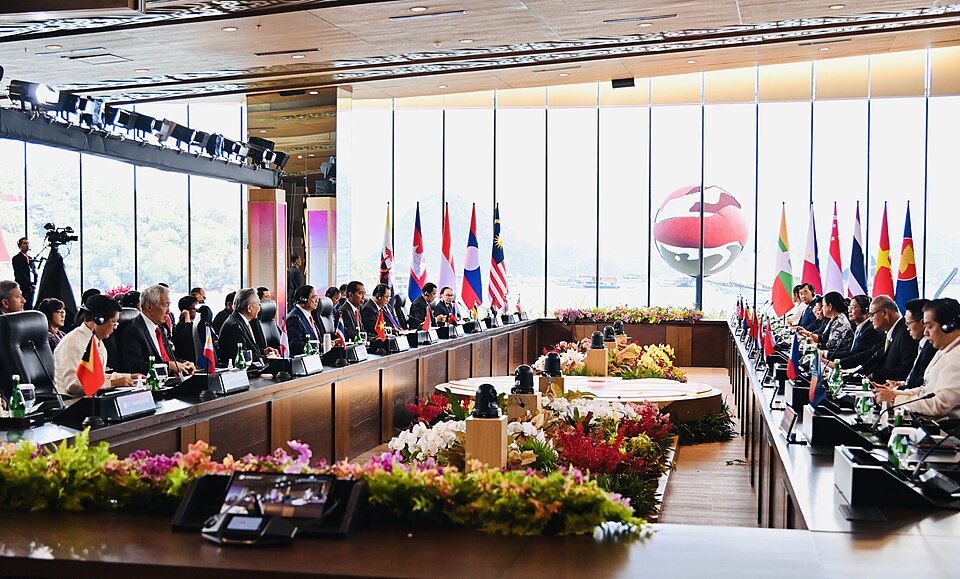
ASEAN plans to sign the world’s first region-wide digital economy agreement at its November summit in the Philippines. The Digital Economy Framework Agreement, known as DEFA, covers data governance, AI co-operation, digital identity, cybersecurity and digital trade. Supporters have called it a “game-changer.”
The timing matters. The World Trade Organization’s moratorium on customs duties on electronic transmissions expired in March 2026, and global rules for digital trade are less certain than they were.
ASEAN leaders want a digital economy worth C$2.8 trillion by 2030. They are not starting from zero. By 2025 the region’s digital economy had passed C$420 billion, growing about 15 per cent a year. Digital trade exports rose nearly 10 per cent annually between 2004 and 2022 and reached C$542 billion, close to one-fifth of all ASEAN exports.
Money is following. AI-related investment makes up nearly one-third of private digital economy funding in Southeast Asia, and data centre capacity in the region is projected to nearly triple.
Built to bend
DEFA rests on nine pillars, including data governance, digital trust, cybersecurity, infrastructure, talent and innovation. It is not a fixed treaty. It sets up a long-term framework that can grow through later protocols and implementing arrangements.
That follows the “ASEAN Minus X” habit: members ready to adopt new commitments go ahead, and the others get more time. The ten economies sit at very different stages of digital development, so the agreement will probably lean on regulatory co-ordination, capacity building and phased rollout rather than formal dispute settlement.
What it means for Canada
The Asia Pacific Foundation of Canada has urged Canadian firms to start assessing the effects. Canada is not a party to DEFA, but companies working in the region will increasingly operate under rules shaped by it.
The sequencing of the talks is telling. Provisions on AI, talent mobility, competition policy, cybersecurity and online safety were largely settled by October 2025. Cross-border data flows, personal data protection, digital identity and digital payments took longer. Those are the issues closest to national regulatory authority, and the ones Canadian firms care about most.
Data rules already differ. Malaysia passed a data protection framework in 2010, the Philippines and Singapore in 2012, Indonesia and Thailand in 2022, and Vietnam in 2023. Some members push for freer data flows. Others stress domestic oversight, localization or government access to sensitive records. Canadian firms will keep meeting national rules market by market, not one regional standard.
DEFA is due to be signed in November 2026, with ratification expected within 180 days. Canada already takes part in the G7-led Data Free Flow with Trust initiative and OECD frameworks such as the AI Principles and Privacy Guidelines, so it has a chance to influence the debate before regional practice sets.
Alongside existing deals
Chapter 14 of the CPTPP remains the main framework for Canada’s digital trade in the region. It covers electronic commerce, data flows, data localization, source code protection, privacy and consumer protection. The Canada-Indonesia trade agreement extends similar commitments to Indonesia, and a Canada-ASEAN free trade deal is still under negotiation. Brunei, Malaysia, Singapore and Vietnam belong to both the CPTPP and DEFA. Indonesia is not in the CPTPP.
CPTPP Chapter 14 was written before generative AI and has no dedicated AI governance. DEFA’s emerging technologies pillar names AI directly and ties in with the ASEAN Guide on AI Governance and Ethics (2024), the Expanded Guide for Generative AI (2025) and the ASEAN Responsible AI Roadmap 2025-2030.
Others are building too
China signed the upgraded ASEAN-China Free Trade Area 3.0 in October 2025, with a dedicated digital economy chapter and new work on AI and digital skills. The United States has focused on supply chains through Pax Silica, a coalition covering semiconductors, AI, critical minerals and data infrastructure. The Philippines joined as a full signatory in 2026 and is expected to host the first AI-focused industrial hub, in the Luzon Economic Corridor.
In May 2026, 17 countries launched the Guiding Principles for Underwater Infrastructure Defence Exchanges, known as GUIDE, to protect subsea cables. Members include Australia, Brunei, France, Malaysia, New Zealand, the Philippines, Singapore, Thailand and the United Kingdom. Canada has not joined GUIDE or Pax Silica.




