
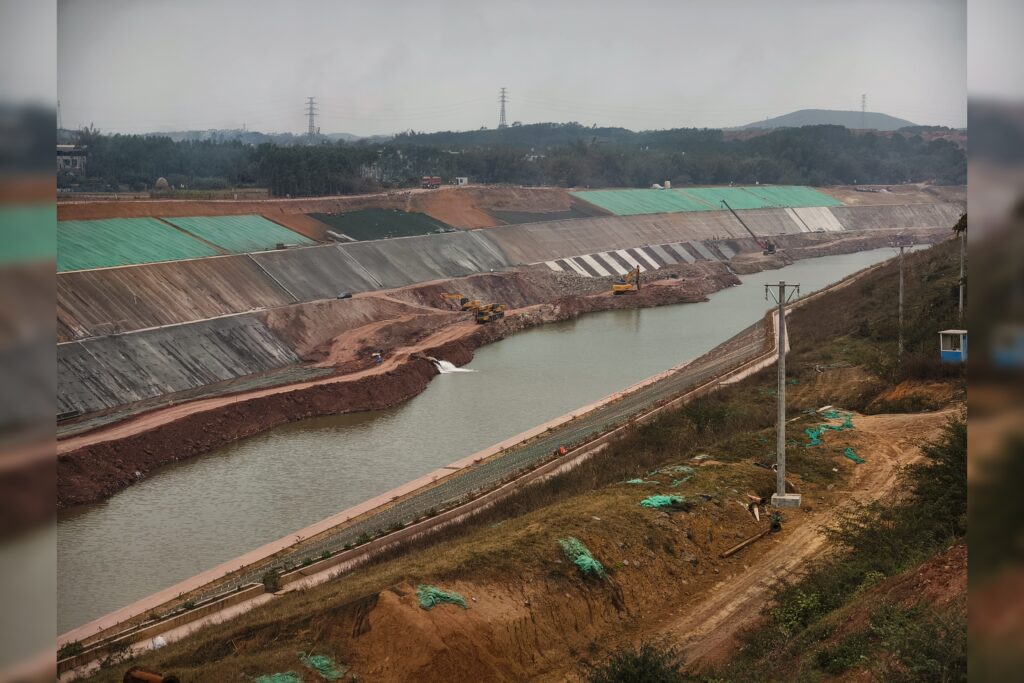
Thirty cargo ships went through the Pinglu Canal on its first day, CCTV News reported. They sailed from Nanning and Qinzhou in Guangxi carrying containers, coal, steel, fertiliser, minerals and construction materials.
The canal opened on a Wednesday after four years of construction. It runs 134.2 kilometres and links Hengzhou, an inland county in Guangxi, with ports on the Beibu Gulf, also called the Gulf of Tonkin. It cost 72.7 billion yuan, about US$10.8 billion. Chinese authorities estimate it will cut logistics costs by more than US$770 million a year.
Why Beijing built it
Cargo from China’s southwest now has a direct river-to-sea route, and trips to ASEAN markets get shorter by more than 560 kilometres. The timing fits a wider push. China and ASEAN have been each other’s largest trading partner for six years running, and their trade rose 18.2 per cent year on year to 4.34 trillion yuan in the first half of 2026, according to Chinese customs data. Beijing is also trying to spread its trade beyond the United States.
Money is already moving along the route. Nanning’s canal economic belt signed 133 projects of at least 50 million yuan each in the first half of the year, including new energy and battery plants, with combined investment of 56.6 billion yuan, Xinhua reported. Sichuan has started river-rail-sea services to ASEAN through Guangxi, giving its battery, solar and machinery makers a shorter path south, CCTV said.
Li Hengchang, deputy general manager of Pinglu Canal Group, said most cargo will come from Yunnan, Guizhou, Sichuan, Chongqing and Guangxi itself: non-ferrous metals, construction materials, minerals, farm and forestry products. The operator also wants to draw ASEAN containers and foreign trade cargo through to Beibu Gulf ports.
The doubts
Tianchen Xu, a senior economist at the Economist Intelligence Unit, said the canal should lower costs for export industries in Guangxi and neighbouring provinces that have relied on road and rail. “If goods can head straight south through the canal to Beibu Gulf, the logistic savings should be fairly obvious,” he told Lloyd’s List. He added a catch. Cheaper transport could put southwestern Chinese manufacturers in sharper competition with producers in Southeast Asia, especially in lower-value goods.
The canal takes vessels of only 5,000 tonnes. Jayendu Krishna of Drewry’s maritime advisory practice called a man-made canal of that scale “fairly small” in international shipping. A typical intra-Asia vessel carries roughly 20,000 to 50,000 tonnes. “The economies of scale are obviously not as great,” he said.
Krishna described the project as a strategic priority more than a commercial one. “I’m not sure what the payback period is going to be,” he said. “It’s probably going to be a really long time for a $10bn investment.”




