Russia has passed technical documentation and submarine-testing materials to China as part of a cooperation that stretches back to the 2010s, according to a report titled “A Marriage of Convenience?” from the research group Center for Advanced Defense Studies (C4ADS). The report says the exchange carried on after Russia launched its full-scale invasion of Ukraine in February 2022.
Old roots, shared engineering
China’s submarine force, especially its conventional boats, began with Soviet and Russian designs before the Chinese Navy moved to domestic platforms. Experts cited in the report say the cooperation covers noise reduction, non-nuclear propulsion, automated command, control and weapon management systems, and hull design. U.S. government sources claim China’s nuclear submarine program still gets significant Russian help, particularly in reducing acoustic signature. Analysts have also suggested that Moscow’s help with quieting came in return for Chinese assistance during the war in Ukraine, though that remains an assessment, not a documented fact.
What the trade data show
One Russian organization sits at the center: the Central Design Bureau for Marine Engineering Rubin, a subsidiary of the state-owned United Shipbuilding Corporation. The United States, the European Union and Japan have sanctioned it. Trade data indicate that from at least August 2015 through April 2023, Rubin worked with procurement agencies of the People’s Liberation Army and with China Shipbuilding and Offshore International Co., Ltd. (CSOC), the foreign trade arm of the China State Shipbuilding Corporation, on joint submarine development.
Rubin made 12 deliveries to PLA Navy procurement agencies and CSOC worth more than $80 million. The report’s authors say the vague descriptions probably point to conceptual designs for a non-nuclear submarine. Two shipments to CSOC, in October 2019 and January 2020, included documents on submarine tests, among them tests of cavitation, a natural effect that undermines a submarine’s stealth. A maritime security expert consulted by the authors read this as evidence that Rubin helped CSOC check Chinese noise-reduction technology.
The traffic ran both ways. From December 2019 to September 2022, CSOC sent Rubin materials for submarine testing, including control devices and parts of test consoles used to evaluate a boat’s information and control system. Paperwork tied to a September 2022 shipment also mentions a contract for joint design and production.
The force today
The People’s Liberation Army Navy’s submarine force operates 66 boats, nuclear and conventional, across the North Sea, East Sea and South Sea fleets. Among the nuclear boats, the Type 094 ballistic missile submarine is believed to have been influenced by Russian assistance. It carries 12 tubes for the JL-2 missile, which has a range of 8,000 kilometers and can hold three to four independently targetable warheads.
On the conventional side, an author writing under the name Yin He, in the March 2026 issue of the PRC navalist journal Shipborne Weapons, described how the Type 039B improved on the Type 039A in propulsion, acoustic quieting and overall performance. The Naval War College’s China Maritime Studies Institute translated the piece. The boat carries the Yu-6 torpedo for both submarine and surface targets, the long-range YJ-18 anti-ship missile, derived from Russia’s Club-S but substantially redesigned for Chinese needs, and a new integrated sonar and combat-command suite with large passive flank arrays. The institute noted that the journal is not an official PLA publication, but that the author seems well informed about navy requirements.
Yin He describes a “small-step, fast-iteration” approach. The Type 039C adds an axe-shaped sail, an X-shaped rudder and composite materials meant to improve stealth and maneuverability, and the author sees it as a possible test platform for new designs, propulsion and weapons. The navy will still need conventional boats for the near seas, he argues, perhaps running on lithium-ion batteries. Future all-electric submarines would need solid-state batteries, integrated electric propulsion, medium-voltage DC power distribution and supercapacitor energy storage.
Sources
- Russia Transferred Non-Nuclear Submarine Technology to China
- People's Liberation Army Navy Submarine Force
- Andrew S. Erickson
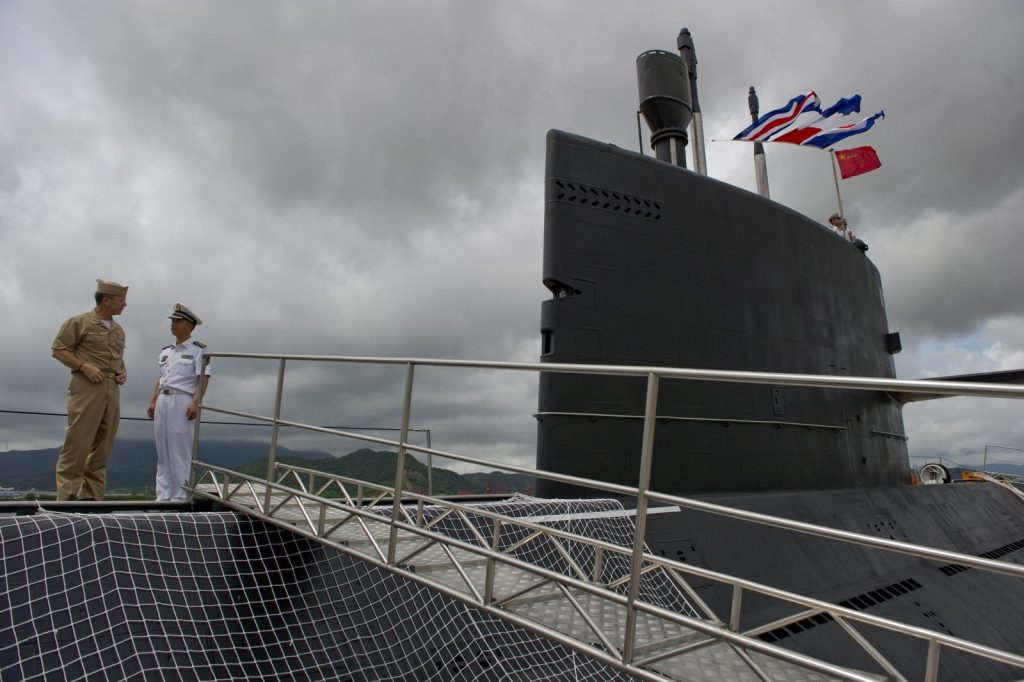
Photo: Chairman of the Joint Chiefs of Staff from Washington D.C, United States (CC BY 2.0)